DOT Drug Testing Requirements: Complete Guide for Employers and CDL Drivers
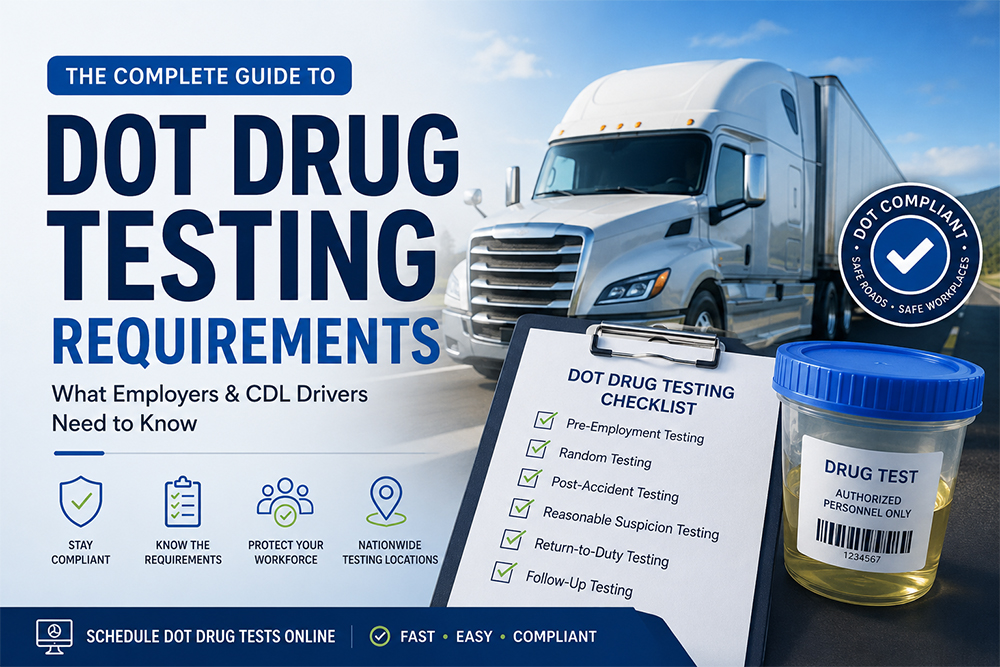
The U.S. Department of Transportation (DOT) requires drug and alcohol testing to keep America’s roads, railways, pipelines, aviation, and public transit systems safe. If your business employs commercial drivers or safety-sensitive workers regulated by the DOT, understanding DOT drug testing requirements is essential for maintaining compliance and avoiding costly penalties.
Whether you’re a trucking company, bus operator, pipeline contractor, aviation employer, or a CDL driver, this guide explains who must be tested, when testing is required, what drugs are screened, employer responsibilities, and how to schedule a compliant DOT drug test online.
What Is DOT Drug Testing?
DOT drug testing is a federally regulated drug screening program required for employees performing safety-sensitive functions under the Department of Transportation.
Unlike standard workplace drug testing, DOT testing follows strict federal regulations under 49 CFR Part 40 and agency-specific rules established by:
- Federal Motor Carrier Safety Administration (FMCSA)
- Federal Aviation Administration (FAA)
- Federal Railroad Administration (FRA)
- Federal Transit Administration (FTA)
- Pipeline and Hazardous Materials Safety Administration (PHMSA)
- United States Coast Guard (USCG)
The purpose is to ensure employees working in safety-sensitive positions are free from prohibited drug use while performing their duties.
Who Must Comply with DOT Drug Testing Requirements?
DOT regulations apply to employers and employees involved in transportation industries regulated by the federal government.
Common industries include:
- Trucking companies
- Commercial bus companies
- Public transit agencies
- Aviation companies
- Railroad operators
- Pipeline companies
- Maritime employers
- Hazardous materials transportation
Employees commonly covered include:
- CDL drivers
- Bus drivers
- Pilots
- Flight crew members
- Railroad engineers
- Train conductors
- Pipeline operators
- Vessel crew members
If an employee performs a DOT-defined safety-sensitive job, DOT drug testing requirements apply regardless of company size.
DOT Drug Testing Requirements for Employers
Every DOT-regulated employer must establish a compliant drug and alcohol testing program.
Employer responsibilities include:
- Maintaining a written DOT drug and alcohol policy
- Conducting required DOT drug tests
- Selecting qualified collection sites
- Using SAMHSA-certified laboratories
- Working with a Medical Review Officer (MRO)
- Maintaining testing records
- Providing supervisor training
- Conducting random testing according to annual testing rates
- Reporting violations when required (such as FMCSA Drug & Alcohol Clearinghouse)
Failure to comply may result in audits, fines, enforcement actions, and legal liability.
When Is DOT Drug Testing Required?
DOT regulations require testing under several circumstances.
1. Pre-Employment Drug Testing
Before performing safety-sensitive duties, employees must:
- Pass a DOT urine drug test
- Receive a verified negative result
- Complete required Clearinghouse queries (FMCSA)
No employee may begin safety-sensitive work until these requirements are met.
2. Random DOT Drug Testing
Random testing is one of the most important DOT compliance requirements.
Employees are randomly selected throughout the calendar year using a scientifically valid selection process.
Random testing:
- Must be unannounced
- Must be spread reasonably throughout the year
- Cannot be predictable
- Applies to all safety-sensitive employees
Selected employees must proceed to testing immediately after notification.
3. Post-Accident Drug Testing
DOT regulations require testing following certain qualifying accidents.
Depending on the DOT agency, testing may be required when:
- Fatalities occur
- Citations are issued
- Vehicles require towing
- Serious injuries occur
- Agency-specific criteria are met
DOT Time Limits
Drug testing should occur:
- As soon as practical
- Within 32 hours if possible
Alcohol testing should occur:
- Within 8 hours
Prompt action is essential to remain compliant.
4. Reasonable Suspicion Testing
A supervisor who has received required DOT training may order testing when there is reasonable suspicion of drug or alcohol use.
Indicators may include:
- Slurred speech
- Unsteady movements
- Odor of alcohol
- Impaired coordination
- Behavioral changes
- Confusion
- Unsafe operation
Supervisors should document observations before testing.
5. Return-to-Duty Testing
Employees who violate DOT drug and alcohol regulations must complete the return-to-duty process before resuming safety-sensitive work.
This includes:
- Evaluation by a Substance Abuse Professional (SAP)
- Education or treatment recommendations
- Return-to-duty drug test
- Negative test result
6. Follow-Up Testing
After returning to work, employees remain subject to unannounced follow-up testing.
These tests are directed by the Substance Abuse Professional and may continue for several years.
What Drugs Does a DOT Drug Test Screen For?
DOT regulations require testing for the following drug classes:
- Marijuana (THC metabolites)
- Cocaine
- Amphetamines
- Methamphetamine
- MDMA (Ecstasy)
- MDA
- Opioids including:
- Codeine
- Morphine
- Heroin metabolite (6-AM)
- Hydrocodone
- Hydromorphone
- Oxycodone
- Oxymorphone
These substances are tested using federally established cutoff concentrations.
Does DOT Drug Testing Include Alcohol?
Yes.
Alcohol testing is required in several situations, including:
- Random testing (for applicable agencies)
- Reasonable suspicion
- Post-accident
- Return-to-duty
- Follow-up
DOT alcohol testing uses an approved Evidential Breath Testing (EBT) device or saliva alcohol screening under DOT procedures.
What Type of Drug Test Is Used?
DOT regulations currently require:
DOT Urine Drug Test
The urine specimen must be collected under strict chain-of-custody procedures following 49 CFR Part 40 requirements.
Unlike many non-DOT programs, employers cannot substitute another specimen type for federally required DOT urine drug testing.
DOT Drug Testing Cutoff Levels
DOT laboratories follow federally established cutoff concentrations.
Initial screening and confirmation testing use different cutoff levels to minimize false positives and ensure reliable results.
Only laboratories certified by SAMHSA may perform federally regulated DOT testing.
Can Prescription Medications Affect DOT Drug Tests?
Yes.
Certain legally prescribed medications may appear during laboratory analysis.
However:
- The Medical Review Officer contacts the donor when necessary.
- Valid prescriptions are reviewed.
- Legitimate medical use is evaluated according to DOT procedures.
Drivers should never discontinue prescribed medications without consulting their healthcare provider.
What Happens If an Employee Tests Positive?
A verified positive DOT drug test generally means the employee must immediately stop performing safety-sensitive duties.
The employee must then complete the DOT return-to-duty process, which typically includes:
- Removal from safety-sensitive work
- Substance Abuse Professional evaluation
- Treatment or education
- Return-to-duty testing
- Follow-up testing program
Employer Recordkeeping Requirements
DOT employers must maintain testing records for specified retention periods.
Records commonly include:
- Drug test results
- Alcohol test results
- Random selection documentation
- Training records
- Policy acknowledgments
- Chain of Custody Forms
- Annual summaries when applicable
Proper documentation is critical during DOT audits.
Common DOT Drug Testing Mistakes Employers Should Avoid
Many compliance violations occur because employers overlook administrative requirements rather than the testing itself.
Avoid these common mistakes:
- Using non-DOT tests for DOT-regulated employees
- Missing pre-employment requirements
- Failing to conduct random testing at required rates
- Not documenting reasonable suspicion observations
- Using unauthorized collection sites
- Incomplete employee records
- Delayed post-accident testing
- Failure to complete Clearinghouse requirements
- Outdated drug and alcohol policies
Working with an experienced nationwide testing provider helps reduce these risks.
Benefits of Using an Online DOT Drug Testing Service
Modern employers can simplify compliance by scheduling DOT drug tests online.
Benefits include:
- Nationwide collection site network
- Fast online ordering
- Electronic registration
- Secure employer portal
- Employee notifications
- Compliance-focused testing process
- Reliable laboratory testing
- Medical Review Officer verification
- Convenient scheduling for individual or multiple employees
For employers with drivers across multiple states, online scheduling reduces administrative workload while helping maintain DOT compliance.
How to Schedule a DOT Drug Test Online
Scheduling a DOT drug test is straightforward:
- Place your order online.
- Enter employee information.
- Select the required DOT drug test.
- Receive registration details.
- Employee visits a nearby collection site.
- Laboratory testing is completed.
- Verified results are securely delivered.
Many nationwide providers offer thousands of collection locations, making it convenient for employees to test wherever they are working.
Frequently Asked Questions
Is DOT drug testing mandatory?
Yes. Employers regulated by the DOT must comply with federal drug and alcohol testing regulations for employees performing safety-sensitive duties.
Can I use a non-DOT drug test for CDL drivers?
No. Employees subject to DOT regulations must receive federally regulated DOT drug tests when required.
How long does DOT drug test processing take?
Most verified results are available within 1–3 business days for negative tests, while non-negative results may require additional Medical Review Officer review.
Are all CDL drivers subject to DOT drug testing?
Most CDL drivers operating commercial motor vehicles in safety-sensitive positions are subject to DOT drug testing requirements.
Can employers schedule DOT drug tests online?
Yes. Many employers schedule DOT-compliant drug tests online through nationwide providers, making it easy to test employees at convenient collection sites across the United States.