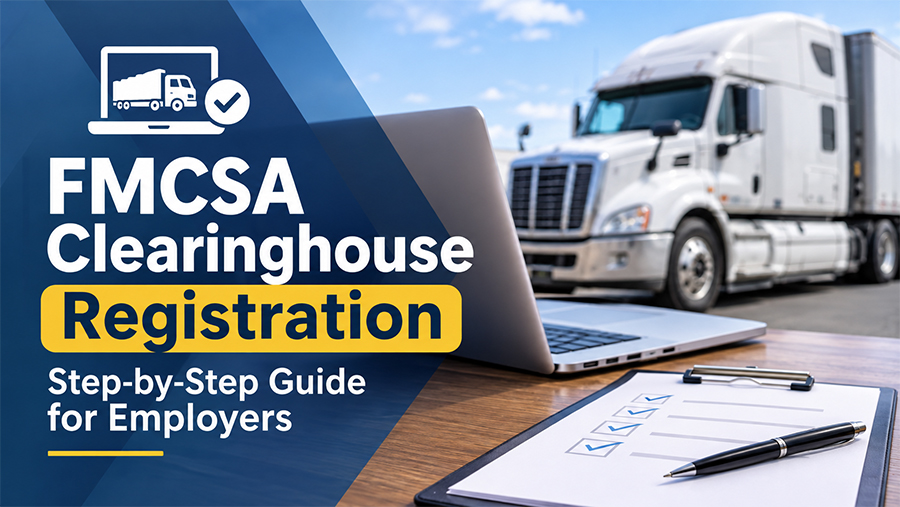
FMCSA Clearinghouse Registration: A Step-by-Step Guide for Employers
Running a trucking company involves more than hiring qualified drivers and keeping vehicles on the road. Employers also need to make sure their drivers meet federal drug and alcohol testing requirements. One important part of that responsibility is registering with the FMCSA Drug and Alcohol Clearinghouse.
If you employ CDL drivers, you have probably heard about the FMCSA Clearinghouse. But knowing that it exists and understanding how to use it are two different things.
The Clearinghouse is an online database that helps employers check whether a CDL driver has a record of a drug or alcohol program violation that could prevent them from performing safety-sensitive duties. It also gives employers a place to report certain violations and manage required driver queries.
For new trucking companies, small fleet owners, and owner-operators, getting started can feel a little confusing. Which account should you create? What information do you need? How do you check a driver’s record? And what happens after registration?
This guide walks you through the FMCSA Clearinghouse registration process, explains what employers need to do after signing up, and shows how a DOT consortium or third-party administrator (C/TPA) can help make compliance easier.
What Is the FMCSA Drug and Alcohol Clearinghouse?
The FMCSA Drug and Alcohol Clearinghouse is a secure online database managed by the Federal Motor Carrier Safety Administration.
It was launched on January 6, 2020, to help prevent drivers with unresolved drug and alcohol program violations from performing safety-sensitive functions for employers covered by FMCSA regulations.
In simple terms, it gives trucking companies a way to check a driver’s Clearinghouse record before allowing them to operate a commercial motor vehicle.
The database contains information about certain violations, including:
- Positive DOT drug test results.
- Alcohol confirmation test results of 0.04 or greater.
- Refusals to take required drug or alcohol tests.
- Other violations that must be reported under FMCSA regulations.
- Return-to-duty process information.
The Clearinghouse helps employers make more informed hiring and driver management decisions. It does not replace your DOT drug and alcohol testing program. Employers must continue to meet all applicable testing, reporting, and recordkeeping requirements.
Who Needs to Register for the FMCSA Clearinghouse?
If your company employs CDL drivers who perform safety-sensitive functions and is subject to FMCSA drug and alcohol testing regulations under 49 CFR Part 382, Clearinghouse registration is part of your compliance responsibilities.
This includes many businesses involved in commercial transportation, such as:
- Trucking and freight transportation companies.
- Motor carriers operating commercial vehicles.
- Private companies operating CDL-required vehicle fleets.
- Passenger transportation companies are covered by FMCSA regulations.
- School bus operators subject to applicable FMCSA requirements.
- Other businesses employing drivers are covered by federal DOT testing rules.
You do not need to operate a large fleet to have these responsibilities. Even a small trucking company with just a few CDL drivers may need to register and conduct the required queries.
Do Owner-Operators Need to Register?
Yes. Owner-operators who are subject to FMCSA regulations also have Clearinghouse responsibilities.
The process is slightly different for owner-operators because they often act as both the employer and the driver.
Under FMCSA requirements, an owner-operator must designate a consortium/third-party administrator (C/TPA) to perform certain Clearinghouse and DOT drug and alcohol program functions on their behalf.
Working with a C/TPA can help owner-operators manage their testing schedules, random testing participation, and Clearinghouse responsibilities without having to handle every administrative task themselves.
What Do You Need Before Registering?
Before starting your registration, take a few minutes to gather your business information. Having everything ready can make the process easier.
You will generally need:
- A valid email address.
- A Login.gov account.
- Your company’s legal business name.
- Business address and contact information.
- Your USDOT number, where applicable.
- Any additional business verification information requested during registration.
You should also decide who in your company will manage the Clearinghouse account. This could be the business owner, safety manager, HR manager, or another authorized employee.
Each person should use their own Login.gov credentials rather than sharing account passwords.
How to Register for the FMCSA Clearinghouse: Step-by-Step
The FMCSA Clearinghouse registration process is completed online. Follow these steps to get your employer account started.
Step 1: Visit the Official FMCSA Clearinghouse Website
Start by visiting:
https://clearinghouse.fmcsa.dot.gov/
This is the official website where employers, drivers, and C/TPAs can access the Clearinghouse.
Select the registration or sign-in option to begin.
Make sure you are using the official FMCSA website. Avoid entering your company information on unofficial websites claiming to provide government registration.
Step 2: Sign In or Create a Login.gov Account
The Clearinghouse uses Login.gov to verify users and provide secure access.
If you already have a Login.gov account, you can use your existing credentials.
If you are new to Login.gov:
- Select the option to create an account.
- Enter your email address.
- Verify your email.
- Create a secure password.
- Set up multi-factor authentication.
- Complete any required identity verification.
Keep your Login.gov information secure. You will use this account to access the Clearinghouse.
Step 3: Choose the Employer Registration Option
Once you have signed in, follow the Clearinghouse registration instructions.
Select the Employer role if you are registering on behalf of a trucking company or motor carrier.
If you are registering as a service provider or consortium administrator, choose the appropriate role for your organization.
One important point: The registration process may differ depending on whether your company already has an FMCSA Portal account. Follow the official FMCSA instructions that apply to your situation.
Step 4: Enter Your Company Information
Next, provide the business information requested by the Clearinghouse.
This may include:
- Legal company name.
- Business address.
- Contact information.
- USDOT number, where applicable.
- Other employer identification details.
Double-check everything before moving forward. Incorrect information can create verification problems or make it harder to manage your company’s drivers later.
Step 5: Complete the Required Verification
FMCSA may need to verify your company’s information before activating the employer account.
Follow the instructions displayed on the website. If additional information or documentation is requested, provide it through the official process.
Do not assume registration is complete until you have finished all required verification steps and can access the appropriate employer functions.
Step 6: Review and Accept the Terms
Before completing registration, review the applicable terms, privacy information, and employer responsibilities.
You should understand what is expected of your company, particularly regarding driver queries, violation reporting, and recordkeeping.
Complete the required acknowledgments and submit your registration.
Step 7: Access Your Employer Dashboard
After completing registration, sign in to your Clearinghouse account and become familiar with the employer dashboard.
Depending on your account permissions, you can:
- Search for CDL drivers.
- Purchase query plans.
- Conduct limited and full queries.
- Review query results.
- Report applicable drug and alcohol violations.
- Designate a C/TPA.
- Manage authorized users.
Take some time to understand these functions. Your Clearinghouse account will be an important part of your company’s ongoing DOT compliance process.
How Do Employers Check a Driver’s FMCSA Clearinghouse Record?
After registering, one of the most important things employers need to understand is how driver queries work.
A Clearinghouse query allows an employer to check whether a CDL driver has information in the database that may affect their eligibility to perform safety-sensitive duties.
There are two types of queries: limited and full.
Limited Query: A Basic Record Check
A limited query tells you whether information exists in a driver’s Clearinghouse record. It does not show the details of the violation.
Employers must conduct a limited or full query at least once every 12 months for each currently employed CDL driver.
A limited query requires the driver’s general consent. This can be obtained electronically through the Clearinghouse or through a separate written consent process that meets FMCSA requirements.
If the limited query shows that information exists, the employer must conduct a full query to find out what the record contains.
Full Query: A Detailed Record Check
A full query provides detailed information about a driver’s Clearinghouse record.
Employers must conduct a full query before allowing a prospective CDL driver to perform safety-sensitive functions for the first time.
A full query is also necessary when a limited query indicates that information exists in the driver’s record.
The driver must provide electronic consent through the Clearinghouse before a full query can be completed.
If the driver does not provide the required consent, the employer cannot allow that driver to perform safety-sensitive functions.
A useful reminder: A limited query only tells you whether information exists. A full query helps you determine whether the driver has a violation that makes them prohibited from performing safety-sensitive duties.
What Should Employers Do If a Driver Has a Clearinghouse Violation?
Finding a violation in a driver’s Clearinghouse record does not necessarily mean the driver can never return to work. However, the employer must take the appropriate steps before allowing that driver to perform safety-sensitive functions.
A driver with a violation that results in a prohibition must complete the applicable return-to-duty process.
Depending on the circumstances, this may involve:
- Meeting with a qualified substance abuse professional (SAP).
- Completing the education or treatment recommended by the SAP.
- Completing a return-to-duty test with a negative result.
- Completing follow-up testing as directed by the SAP.
The employer must verify that the driver has completed the required process and is no longer prohibited before allowing them to return to safety-sensitive duties.
Employers should not rely on verbal assurances from drivers. Check the Clearinghouse and follow the applicable FMCSA requirements.
What Are the Ongoing Clearinghouse Responsibilities for Employers?
Registering for the Clearinghouse is only the beginning. Employers must continue managing their responsibilities throughout their relationship with covered CDL drivers.
Here are the key areas to pay attention to.
1. Complete Pre-Employment Queries
Before allowing a newly hired CDL driver to perform safety-sensitive functions, conduct a full Clearinghouse query.
Make this part of your regular driver hiring and qualification process.
2. Don’t Miss Annual Queries
Employers must conduct a limited or full query at least once every 12 months for each currently employed CDL driver.
For companies with multiple drivers, keeping track of individual query dates can become difficult.
A simple compliance calendar or regular review process can help prevent missed deadlines.
3. Report Required Violations
Employers must report specified drug and alcohol program violations within the applicable FMCSA deadlines.
These include certain positive drug test results, alcohol confirmation test results of 0.04 or greater, refusals to test, and other reportable violations.
Make sure the person responsible for your DOT program understands which violations must be reported and when.
4. Obtain Proper Driver Consent
Driver consent is an important part of the query process.
Remember the distinction:
- Limited queries require general consent.
- Full queries require electronic consent through the Clearinghouse.
Keep the necessary consent documentation and follow the required procedures.
5. Maintain Proper Records
Keep your testing records, query documentation, consent information, and other required compliance records organized.
This will make it easier to respond to audits, review driver histories, and manage your company’s DOT responsibilities.
Can a DOT Consortium or C/TPA Help With Clearinghouse Queries?
Yes. This is particularly helpful for small trucking companies and owner-operators that do not have a dedicated safety or compliance department.
A consortium/third-party administrator (C/TPA) can perform certain Clearinghouse and DOT drug and alcohol program functions when properly designated and authorized.
Depending on the services provided, a C/TPA can help with:
- Conducting authorized Clearinghouse queries.
- Reporting applicable drug and alcohol program violations.
- Managing DOT random testing participation.
- Coordinating pre-employment and other required testing.
- Monitoring annual query schedules.
- Organizing drug and alcohol testing records.
- Supporting ongoing DOT compliance activities.
For example, imagine you own a small trucking company with five CDL drivers. You need to manage random testing, complete annual Clearinghouse queries, coordinate pre-employment tests, and keep track of important deadlines.
Instead of managing every task yourself, you can work with a C/TPA to handle the functions you authorize and provide support with your DOT testing program.
Keep in mind that employers remain responsible for ensuring their company meets applicable FMCSA requirements. A C/TPA supports your compliance process; it does not remove your legal responsibilities.
Also, employers should purchase their own Clearinghouse query plans. A C/TPA cannot purchase query plans on an employer’s behalf.
Common FMCSA Clearinghouse Registration Mistakes to Avoid
Many registration and compliance problems can be avoided with a little preparation.
Here are some mistakes trucking companies should watch out for:
Choosing the wrong registration role: Make sure you select the Employer role when registering on behalf of your motor carrier.
Entering incorrect company information: Double-check your legal business name, USDOT number, and contact information.
Sharing login credentials: Each authorized user should have their own Login.gov account.
Forgetting annual queries: Set reminders to check each covered driver’s Clearinghouse record within the required 12-month period.
Using limited queries when a full query is needed: If a limited query shows that information exists, you must obtain electronic driver consent and conduct a full query.
Not obtaining driver consent: Make sure the appropriate consent is in place before submitting a query.
Assuming registration automatically enrolls you in a DOT consortium: Clearinghouse registration and DOT random testing consortium enrollment are two separate processes.
Thinking a C/TPA takes over all employer responsibilities: A C/TPA can help with delegated tasks, but the employer remains accountable for compliance.
How US Health Testing Helps Trucking Companies Manage DOT Testing
For many trucking companies, DOT compliance is not a full-time job, but it can quickly become a time-consuming responsibility.
Between driver onboarding, random testing, Clearinghouse queries, and recordkeeping, there is a lot to manage.
US Health Testing helps trucking companies, fleet owners, and owner-operators coordinate their DOT drug and alcohol testing needs through nationwide laboratory collection services and DOT program support.
Our services include:
- DOT drug and alcohol testing coordination.
- DOT random testing consortium enrollment.
- FMCSA Clearinghouse query assistance.
- Pre-employment drug testing.
- Random drug and alcohol testing.
- Post-accident testing coordination.
- Nationwide collection through participating Labcorp and Quest Diagnostics locations.
Whether you operate a single truck or manage a growing fleet, having the right testing support can make your compliance responsibilities easier to manage.
Need help with DOT consortium enrollment or FMCSA Clearinghouse queries?
US Health Testing can help you understand the available services and find a suitable testing solution for your business.
Visit US Health Testing to learn more.
Final Thoughts
FMCSA Clearinghouse registration may seem like another administrative task for trucking companies, but it plays an important role in maintaining a safe and compliant workforce.
Getting registered is the first step. Employers also need to conduct pre-employment and annual queries, obtain the required driver consent, report applicable violations, and make sure drivers are eligible before performing safety-sensitive duties.
If you are a small fleet owner or owner-operator, you do not have to manage every part of your DOT testing program alone. Working with a reliable consortium or C/TPA can help simplify the process and keep important compliance tasks organized.
Looking for DOT consortium enrollment or FMCSA Clearinghouse query assistance?
Contact US Health Testing to learn how we can support your DOT drug and alcohol testing program.
Frequently Asked Questions About FMCSA Clearinghouse Registration
1. Is FMCSA Clearinghouse registration mandatory for employers?
Yes, employers subject to FMCSA drug and alcohol testing regulations under 49 CFR Part 382 must register and meet the applicable Clearinghouse requirements. This includes conducting required driver queries and reporting specified violations.
2. Is FMCSA Clearinghouse registration free?
Creating an account is free. However, conducting queries requires an applicable query plan or purchase. Employers should check the official FMCSA website for current query pricing.
3. How long does Clearinghouse registration take?
The time can vary depending on your account information, verification requirements, and whether additional documentation is needed. Make sure you complete all required steps before relying on the account for compliance activities.
4. Do owner-operators need a Clearinghouse account?
Owner-operators covered by FMCSA regulations have Clearinghouse responsibilities. An owner-operator acting as both employer and driver must designate a C/TPA to perform certain required functions on their behalf.
5. What is the difference between a full query and a limited query?
A limited query only indicates whether information exists in a driver’s Clearinghouse record. A full query provides details about that record. Full queries require electronic driver consent through the Clearinghouse.
6. How often should employers check their drivers in the Clearinghouse?
Employers must conduct a pre-employment full query before allowing a prospective CDL driver to perform safety-sensitive functions. They must also conduct a limited or full query at least once every 12 months for each currently employed CDL driver.
7. Can a C/TPA conduct Clearinghouse queries for my company?
Yes. Employers can designate a registered C/TPA to perform authorized Clearinghouse functions on their behalf. The appropriate permissions and driver consent requirements must be in place.
8. Does Clearinghouse registration automatically enroll my company in a DOT random testing consortium?
No. These are separate processes. Registering with the Clearinghouse does not automatically enroll your company in a DOT random testing consortium.
9. What happens if an employer forgets to conduct an annual query?
Failing to conduct required queries can result in FMCSA compliance violations and potential penalties. Employers should maintain a schedule to monitor query deadlines for every covered driver.
10. Where can I register for the FMCSA Clearinghouse?
You can register directly through the official FMCSA website: