How Random Drug Testing Improves Workplace Safety
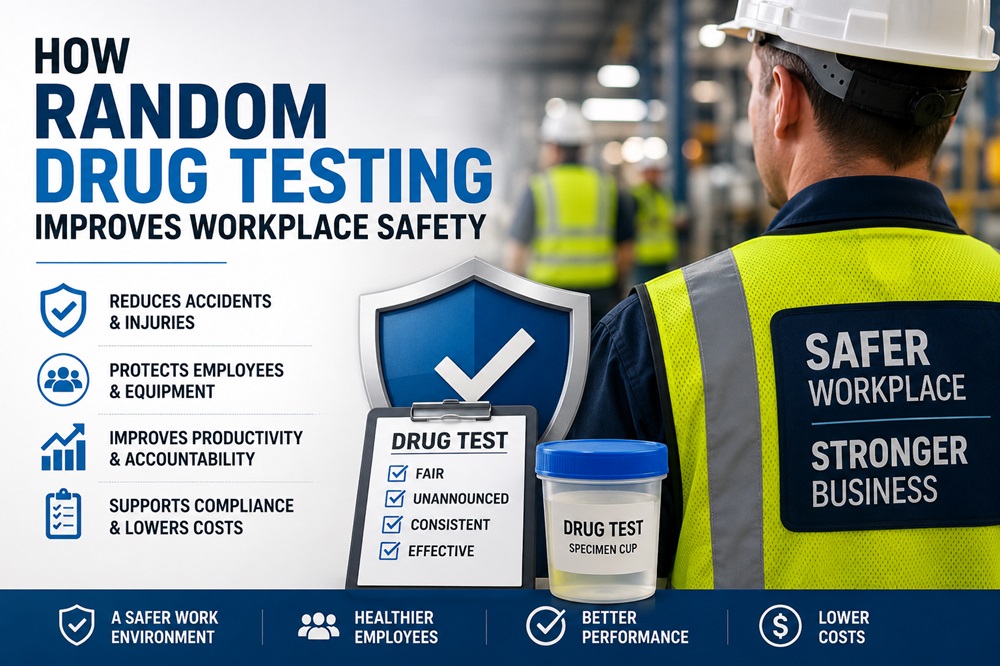
Workplace safety is one of the highest priorities for every employer. Whether you operate a construction company, transportation fleet, manufacturing facility, healthcare organization, warehouse, or office, preventing workplace accidents protects employees, customers, and your business.
One of the most effective ways to reduce workplace risks is implementing a random drug testing program. Unlike pre-employment drug testing, random testing occurs without advance notice, making it a powerful deterrent against drug and alcohol use during employment.
A well-designed random drug testing program helps employers:
- Reduce workplace accidents
- Prevent injuries and fatalities
- Improve employee productivity
- Lower workers’ compensation costs
- Reduce absenteeism
- Increase regulatory compliance
- Promote a culture of safety
This guide explains everything employers need to know about random drug testing, including how it improves workplace safety, legal considerations, best practices, and frequently asked questions.
What Is Random Drug Testing?
Random drug testing is a workplace testing program in which employees are selected for drug testing through a scientifically valid random selection process.
Employees are not chosen based on suspicion, job performance, or personal characteristics. Every eligible employee has an equal chance of being selected each time testing occurs.
The unpredictability of random testing discourages employees from using illegal drugs or misusing prescription medications because they never know when they may be tested.
How Does Random Drug Testing Improve Workplace Safety?
Random drug testing improves workplace safety by discouraging drug use, identifying employees who may pose safety risks, reducing workplace accidents, preventing impaired decision-making, improving employee accountability, and helping employers maintain a drug-free work environment.
Studies consistently show that substance impairment increases the likelihood of:
- Vehicle accidents
- Equipment misuse
- Poor judgment
- Slower reaction times
- Workplace injuries
- Property damage
- Safety violations
Random testing helps reduce these risks before accidents occur.
Why Workplace Drug Use Is a Serious Safety Concern
Drug and alcohol impairment affects both physical and cognitive performance.
Employees under the influence may experience:
- Delayed reaction time
- Poor concentration
- Reduced coordination
- Fatigue
- Impaired judgment
- Increased risk-taking behavior
- Memory problems
Even small amounts of impairment can lead to serious accidents, especially in safety-sensitive positions.
Industries at higher risk include:
- Transportation
- Construction
- Manufacturing
- Oil and gas
- Utilities
- Warehousing
- Mining
- Healthcare
- Aviation
- Public safety
However, every workplace benefits from maintaining a drug-free environment.
How Random Drug Testing Improves Workplace Safety
1. Prevents Drug Use Through Deterrence
The biggest benefit of random testing is prevention.
Employees know they may be tested at any time, making them less likely to use drugs while employed.
Unlike scheduled testing, random testing creates continuous accountability.
This proactive approach reduces the likelihood of employees reporting to work impaired.
2. Reduces Workplace Accidents
Impaired workers are significantly more likely to make mistakes.
Random testing helps identify drug use before it contributes to:
- Slip and fall injuries
- Equipment accidents
- Vehicle crashes
- Forklift incidents
- Machinery injuries
- Electrical accidents
- Chemical exposure incidents
Fewer impaired employees generally result in fewer workplace accidents.
3. Improves Decision-Making
Many jobs require employees to make quick, accurate decisions.
Drug impairment can affect:
- Risk assessment
- Problem-solving
- Communication
- Situational awareness
- Emergency response
Random testing helps ensure employees remain capable of making safe decisions throughout their workday.
4. Protects Employees Working Around Heavy Equipment
Industries involving machinery have little room for error.
Examples include:
- Cranes
- Forklifts
- Bulldozers
- Manufacturing equipment
- Commercial trucks
- Delivery vehicles
- Industrial saws
- Press machines
Even momentary impairment can cause catastrophic injuries.
Random testing reduces this risk.
5. Creates a Strong Safety Culture
Employees notice when management prioritizes safety.
A consistent random drug testing policy communicates that:
- Safety comes first.
- Everyone is treated fairly.
- Policies are enforced consistently.
- Impairment is unacceptable.
Over time, this strengthens workplace culture and encourages employees to take safety seriously.
6. Reduces Human Error
Human error contributes to many workplace incidents.
Drug impairment increases:
- Miscommunication
- Missed procedures
- Incorrect equipment operation
- Safety protocol violations
- Quality control failures
Reducing impairment reduces preventable mistakes.
7. Protects Co-Workers
Drug impairment doesn’t only endanger the impaired employee.
It also puts at risk:
- Coworkers
- Supervisors
- Contractors
- Customers
- Patients
- Members of the public
One impaired employee can cause injuries affecting multiple people.
Random testing helps protect everyone.
8. Encourages Employee Responsibility
Employees become more accountable for maintaining a drug-free lifestyle.
Many organizations report improvements in:
- Attendance
- Professional behavior
- Productivity
- Safety compliance
- Teamwork
Employees understand that workplace safety is everyone’s responsibility.
Business Benefits Beyond Safety
A safer workplace often leads to broader operational improvements.
Lower Workers’ Compensation Costs
Fewer workplace injuries may reduce:
- Medical expenses
- Lost workdays
- Insurance claims
- Workers’ compensation premiums
Reducing accidents can significantly lower long-term costs.
Reduced Absenteeism
Employees struggling with substance misuse often have higher absenteeism rates.
Random testing helps reduce:
- Unplanned absences
- Tardiness
- Missed shifts
- Workplace disruptions
Increased Productivity
Drug-free employees generally demonstrate:
- Better focus
- Improved attendance
- Higher efficiency
- Greater reliability
- Better teamwork
Improved productivity benefits the entire organization.
Reduced Property Damage
Impaired employees are more likely to damage:
- Vehicles
- Machinery
- Equipment
- Inventory
- Buildings
Preventing impairment protects valuable company assets.
Lower Legal Liability
Employers have a responsibility to provide a safe workplace.
A documented drug-free workplace program may help demonstrate that the organization takes reasonable steps to reduce foreseeable safety risks.
This can strengthen an employer’s overall safety and compliance efforts.
Which Industries Benefit Most from Random Drug Testing?
Random drug testing is valuable across many industries, particularly those with safety-sensitive roles.
Transportation
Commercial drivers operate large vehicles that can cause significant harm if operated while impaired.
Random testing is required for many DOT-regulated employees.
Construction
Construction workers often perform high-risk tasks involving:
- Heights
- Heavy machinery
- Power tools
- Excavation
- Electrical work
Random testing helps reduce serious injury risks.
Manufacturing
Manufacturing environments involve:
- Automated machinery
- Presses
- Conveyors
- Industrial equipment
Employee alertness is essential.
Warehousing and Distribution
Forklifts, loading docks, inventory handling, and logistics require employees to remain focused and coordinated.
Healthcare
Healthcare professionals make decisions that directly affect patient safety.
Random testing may help reduce impairment-related risks in safety-sensitive positions.
Energy and Utilities
Employees working around electricity, pipelines, hazardous materials, or heavy infrastructure must maintain full awareness.
Is Random Drug Testing Legal?
In many jurisdictions, random drug testing is legal when conducted in compliance with applicable federal, state, and local laws.
Employers should:
- Develop a written drug-free workplace policy.
- Apply testing fairly and consistently.
- Use a scientifically valid random selection process.
- Respect employee privacy.
- Follow applicable employment laws.
- Work with certified laboratories and qualified Medical Review Officers (MROs) where required.
Because state laws vary, employers should review legal requirements before implementing or modifying a testing program.
Best Practices for an Effective Random Drug Testing Program
A successful program includes more than simply selecting employees at random.
Develop a Clear Written Policy
Include:
- Purpose
- Testing procedures
- Employee rights
- Consequences of positive tests
- Confidentiality procedures
- Return-to-work process
Use Truly Random Selection
Avoid supervisor discretion.
Computer-generated random selection ensures fairness and reduces discrimination concerns.
Test Throughout the Year
Random testing should occur at unpredictable times rather than on a fixed schedule.
Predictability reduces the program’s effectiveness.
Maintain Confidentiality
Protect employee privacy by limiting access to test results and following applicable privacy laws.
Train Supervisors
Managers should understand:
- Company policy
- Reasonable suspicion indicators
- Documentation procedures
- Employee communication
Partner with Certified Laboratories
Using accredited laboratories helps ensure accurate, reliable, and legally defensible results.
Types of Drug Tests Used for Random Testing
Depending on company policy and regulatory requirements, employers may use:
Urine Drug Testing
The most common workplace testing method.
Benefits include:
- Cost-effective
- Widely accepted
- Suitable for random testing
- Laboratory-confirmed results
Hair Drug Testing
Useful for identifying longer-term patterns of drug use.
Oral Fluid (Saliva) Drug Testing
Can detect more recent drug use and may be appropriate in certain workplace settings.
Common Drugs Included in Random Testing
Testing panels vary but may include:
- Marijuana (THC)
- Cocaine
- Amphetamines
- Methamphetamine
- Opiates
- PCP
Expanded panels may also test for additional prescription or synthetic drugs depending on employer needs.
Final Thoughts
Random drug testing is more than a compliance measure—it is a proactive investment in workplace safety, employee well-being, and operational excellence. By discouraging substance use, identifying potential risks early, and reinforcing a culture of accountability, employers can significantly reduce accidents, injuries, and costly disruptions.
When implemented fairly, consistently, and in accordance with applicable laws, a random drug testing program supports safer employees, stronger teams, and more resilient businesses. Combined with clear policies, supervisor training, employee education, and reliable laboratory testing, random testing becomes a key component of a comprehensive workplace safety strategy.
For employers in safety-sensitive industries such as transportation, construction, manufacturing, healthcare, and logistics, maintaining a robust random drug testing program is not only a smart business decision—it is an essential part of protecting people, maintaining compliance, and ensuring long-term organizational success.
Frequently Asked Questions
Does random drug testing actually reduce workplace accidents?
Yes. Random testing acts as a deterrent to workplace drug use and helps employers identify potential safety risks before accidents occur. Organizations with effective drug-free workplace programs often report improved safety performance.
Can employees refuse a random drug test?
Company policies typically outline the consequences of refusing a required test. In many workplaces, refusal may be treated similarly to a positive result, subject to applicable laws and employment agreements.
How are employees selected?
Employees should be selected using a scientifically valid random process, usually through computer-generated software that gives each eligible employee an equal chance of selection.
How often should random drug testing occur?
Testing frequency depends on company policy, industry standards, and legal requirements. Safety-sensitive industries often conduct testing throughout the year on an unpredictable schedule.
Is random drug testing required by law?
Not all employers are required to conduct random testing. However, many DOT-regulated employers must comply with federal random drug and alcohol testing requirements for covered safety-sensitive employees.
Can prescription medications affect results?
Yes. Employees should disclose legally prescribed medications when appropriate. Positive laboratory results are typically reviewed by a Medical Review Officer (MRO), who determines whether there is a legitimate medical explanation.