
Manufacturing Employee Drug Testing: A Complete Guide for Employers
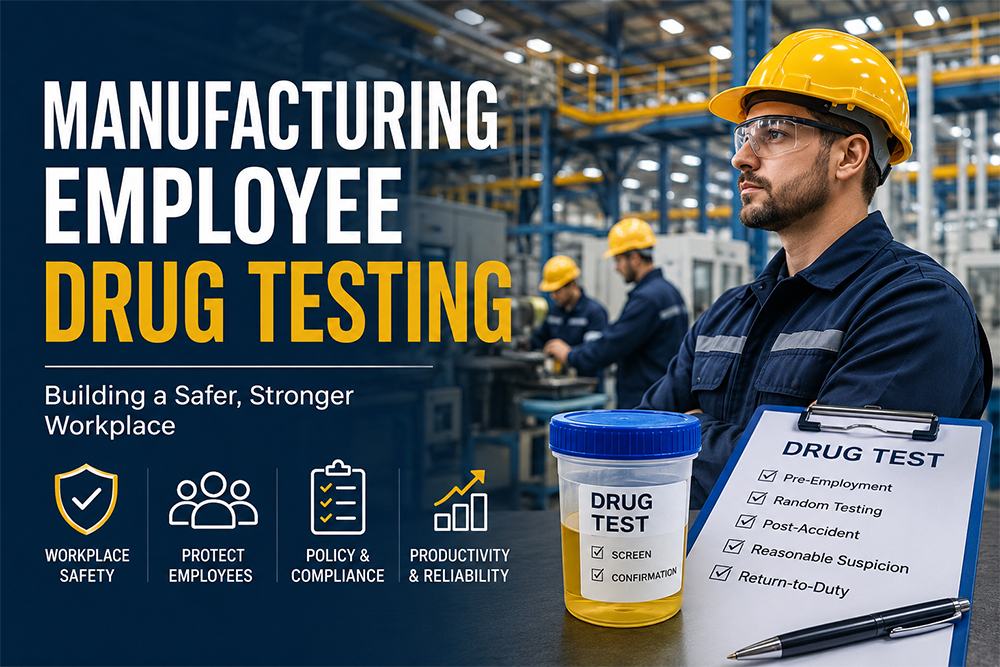
Manufacturing environments depend on employees operating machinery, handling materials, driving equipment, and following strict safety procedures. When drug or alcohol use affects an employee’s judgment, reaction time, coordination, or ability to follow safety protocols, the consequences can extend far beyond the individual employee.
A well-designed manufacturing employee drug testing program can help employers promote workplace safety, reduce operational risks, support compliance requirements, and maintain a productive work environment.
However, workplace drug testing is not simply about ordering a drug test. Manufacturing employers need to understand which employees should be tested, when testing should occur, which specimens and drug panels to use, how testing policies should be written, and how results should be handled confidentially and consistently.
This guide explains everything manufacturing employers should know about implementing an effective employee drug testing program.
What Is Manufacturing Employee Drug Testing?
Manufacturing employee drug testing is the process of testing employees or job applicants for the presence of drugs and, when applicable, alcohol as part of a workplace safety and employment program.
Manufacturers may use drug testing at different stages of the employment lifecycle, including:
- Pre-employment testing
- Post-accident or post-incident testing
- Random drug testing
- Reasonable suspicion testing
- Return-to-duty testing
- Follow-up testing
- Periodic testing
- Testing required by a customer or contract
- DOT-regulated testing for qualifying transportation employees
The purpose of a workplace drug testing program should be clearly defined in the company’s written policy and consistently applied.
For manufacturing companies, testing may be particularly important when employees work with:
- Heavy machinery
- Forklifts and powered industrial trucks
- Production lines
- Industrial equipment
- Hazardous materials
- Chemicals
- Welding equipment
- Presses and cutting equipment
- Electrical systems
- Loading and unloading equipment
- Company vehicles
- Transportation operations
A drug testing program should be part of a broader workplace safety strategy rather than a standalone activity.
Why Is Drug Testing Important in Manufacturing?
Manufacturing workplaces often combine machinery, moving equipment, physical labor, production deadlines, and safety-sensitive responsibilities. Even a momentary impairment can potentially contribute to an accident.
Drug testing can help employers establish a structured process for identifying potential substance-use concerns and maintaining workplace safety.
1. Protects Workplace Safety
Manufacturing employees may operate equipment capable of causing serious injury if used improperly.
Drug or alcohol impairment may affect:
- Reaction time
- Coordination
- Judgment
- Concentration
- Decision-making
- Alertness
- Ability to follow safety procedures
A drug testing program can be one component of a comprehensive workplace safety program.
2. Supports a Drug-Free Workplace
Employers can establish clear expectations regarding drug and alcohol use through a written workplace drug testing policy.
A clearly communicated policy can help employees understand:
- What substances are prohibited
- Who may be tested
- When testing can occur
- What happens after a positive result
- How employees can ask questions
- What consequences may apply
3. Helps Reduce Workplace Risk
Manufacturing accidents can result in:
- Employee injuries
- Equipment damage
- Production downtime
- Workers’ compensation claims
- Increased insurance costs
- Lost productivity
- Regulatory investigations
- Customer concerns
- Employee morale problems
Drug testing alone cannot eliminate these risks, but it can be an important component of a broader risk-management strategy.
4. Supports Customer and Contract Requirements
Some manufacturers work with customers, contractors, government agencies, or other organizations that require employees to participate in workplace drug testing programs.
A documented testing program can help employers meet applicable contractual or organizational requirements.
5. Helps Create Consistent Workplace Standards
A written testing policy establishes consistent procedures rather than leaving testing decisions to individual supervisors.
Consistency is especially important for larger manufacturing organizations with:
- Multiple facilities
- Multiple shifts
- Large employee populations
- Temporary workers
- Contractors
- Remote plants
- Multiple HR teams
Which Manufacturing Employees Should Be Drug Tested?
There is no single testing strategy that applies to every manufacturing company.
Employers should determine their testing population based on job responsibilities, company policy, applicable laws, safety requirements, contracts, and other relevant factors.
Employees who may be included in a manufacturing drug testing program include:
- Production workers
- Machine operators
- Forklift operators
- Warehouse employees
- Maintenance employees
- Mechanics
- Quality-control employees
- Shipping and receiving employees
- Drivers
- Supervisors
- Temporary employees
- New hires
- Safety-sensitive employees
- Contractors, where permitted and applicable
Employers should work with qualified legal or HR professionals when developing or updating a drug testing policy to ensure the program complies with applicable federal, state, and local requirements.
What Drug Test Should a Manufacturing Company Use?
Manufacturers can choose from several specimen types depending on their objectives.
Common workplace drug testing methods include:
Urine Drug Testing
Urine testing is one of the most commonly used workplace drug testing methods.
Advantages can include:
- Widely available collection locations
- Established laboratory procedures
- Multiple drug panel options
- Practical employer workflows
- Suitable for many workplace testing programs
Hair Drug Testing
Hair testing can provide a longer historical detection window than urine testing for many drugs.
Manufacturers may consider hair testing when their program requires a longer detection history.
However, hair testing is different from urine testing and should not automatically be considered a replacement for every testing situation.
Oral Fluid / Saliva Drug Testing
Oral fluid testing can be useful when employers need a different specimen collection method.
It may be considered when the employer’s testing policy and applicable requirements support its use.
Alcohol Testing
Manufacturers may also incorporate alcohol testing into their workplace program when appropriate.
Alcohol testing can be particularly relevant for safety-sensitive positions and workplace policies addressing alcohol use.
What Drugs Are Included in a Manufacturing Drug Test?
The substances included in a workplace drug test depend on the drug panel selected by the employer.
A panel may test for substances such as:
- Marijuana/THC
- Cocaine
- Amphetamines
- Methamphetamine
- Opiates
- Opioids
- Phencyclidine (PCP)
- Benzodiazepines
- Barbiturates
- Methadone
- Buprenorphine
- Other substances
The appropriate panel depends on the company’s objectives, employee population, applicable regulations, and legal requirements.
Employers should not assume that every drug panel tests for the same substances.
DOT vs. Non-DOT Drug Testing in Manufacturing
One of the most important considerations for manufacturing companies is determining whether employees are subject to DOT drug and alcohol testing requirements.
Not every manufacturing employee requires DOT testing.
However, some manufacturing organizations employ drivers or other employees whose duties may place them under U.S. Department of Transportation regulations.
For example, an employee may have manufacturing responsibilities but also perform regulated commercial motor vehicle duties.
DOT Testing
DOT-regulated testing follows specific federal requirements, including requirements concerning:
- Drug testing procedures
- Alcohol testing
- Testing circumstances
- Drug panels
- Collection procedures
- Medical Review Officer review
- Substance abuse professional processes
- Recordkeeping
- Employer responsibilities
Non-DOT Testing
Non-DOT testing is conducted under an employer’s workplace drug testing policy rather than DOT testing requirements.
Employers should clearly distinguish DOT and non-DOT testing and avoid assuming that the same rules apply to both.
Important: Manufacturing employers with DOT-regulated employees should establish separate procedures for DOT-required testing and general workplace testing.
Drug Testing for Manufacturing New Hires
Manufacturers frequently need to fill positions quickly.
Production staffing shortages can affect:
- Production schedules
- Customer orders
- Overtime
- Employee workloads
- Manufacturing capacity
Pre-employment drug testing should therefore fit efficiently into the hiring workflow.
A streamlined process can allow HR teams to:
- Extend a conditional offer.
- Order the appropriate drug test.
- Send testing instructions to the candidate.
- Direct the candidate to a convenient collection location.
- Track testing status.
- Receive the appropriate result.
- Complete the hiring process.
Reducing unnecessary delays can help employers move qualified candidates into open positions faster.
Manufacturing Drug Testing for Forklift Operators
Forklift operators and powered industrial truck operators often work in environments where impaired judgment or delayed reaction times could create serious safety concerns.
A manufacturing company’s drug testing policy may include forklift operators when permitted and appropriate under the employer’s policy and applicable law.
Employers should also maintain appropriate:
- Operator training
- Equipment inspections
- Safety procedures
- Workplace rules
- Supervisor oversight
- Incident reporting
Drug testing should complement—not replace—these safety measures.
Manufacturing Drug Testing for Warehouse Employees
Warehouses connected to manufacturing facilities may involve:
- Forklifts
- Pallet jacks
- Loading docks
- Heavy materials
- Inventory movement
- Trucks
- Automated equipment
Employers may establish drug testing requirements for warehouse employees based on their job duties and company policy.
A comprehensive program should address both manufacturing-floor and warehouse safety responsibilities.
Manufacturing Drug Testing After an Accident
When a workplace accident occurs, the priority should always be employee safety and appropriate emergency response.
After the immediate emergency has been addressed, the employer should follow its established incident-management and drug testing policy.
The policy should specify:
- Which incidents may trigger testing
- Who makes the testing decision
- How quickly testing should occur
- Who arranges the test
- How employees are transported when necessary
- What documentation is required
- How results are handled
Employers should avoid creating a policy that automatically tests employees after every incident without considering applicable legal and regulatory requirements.
How Much Does Manufacturing Employee Drug Testing Cost?
The cost of workplace drug testing depends on several factors, including:
- Drug panel
- Testing method
- Number of employees
- Testing frequency
- Collection location
- DOT or non-DOT requirements
- Alcohol testing
- Additional services
- Program administration
For employers, the total cost of a testing program should be evaluated against the broader cost of workplace incidents, staffing disruptions, equipment damage, and administrative burden.
For high-volume employers, a centralized testing program may also simplify ordering and reporting.
How HR Teams Can Simplify Manufacturing Drug Testing
HR departments can reduce administrative complexity by establishing a standardized process.
Create Standard Testing Workflows
Develop separate workflows for:
- New hires
- Random testing
- Post-incident testing
- Reasonable suspicion
- Return-to-duty
- Follow-up testing
Maintain a List of Approved Testing Locations
Employees should be able to quickly identify where they can complete their test.
Use Online Test Ordering
Online scheduling can help HR teams initiate testing without lengthy manual processes.
Centralize Testing Information
Where appropriate, use a centralized system to manage:
- Orders
- Employee information
- Testing status
- Results
- Documentation
Establish After-Hours Procedures
Make sure supervisors know what to do when an incident occurs outside normal HR hours.
Best Practices for Manufacturing Drug Testing
Manufacturers should consider the following best practices:
1. Put the Policy in Writing
Employees should understand the company’s expectations.
2. Apply the Policy Consistently
Avoid selectively applying testing requirements.
3. Train Supervisors
Supervisors should understand the policy and reasonable suspicion procedures.
4. Protect Employee Privacy
Drug testing information should be handled confidentially and only shared with authorized individuals.
5. Separate DOT and Non-DOT Testing
Use the correct procedures for employees subject to DOT requirements.
6. Review State and Local Requirements
Drug testing laws can vary by jurisdiction.
7. Make Testing Convenient
Convenient collection locations can improve compliance and reduce delays.
8. Prepare for After-Hours Incidents
Manufacturing facilities may operate around the clock.
9. Document Procedures
Clear documentation helps create consistent processes.
10. Review the Program Regularly
Manufacturing operations, laws, regulations, contracts, and company policies can change.
Manufacturing Drug Testing Checklist for Employers
Use this checklist when developing or reviewing your workplace testing program:
- Define the purpose of the drug testing program
- Identify covered employees
- Determine DOT and non-DOT populations
- Develop a written drug and alcohol policy
- Review applicable state and local requirements
- Determine which testing methods to use
- Select appropriate drug panels
- Establish pre-employment testing procedures
- Establish post-incident testing procedures
- Establish reasonable suspicion procedures
- Establish random testing procedures if applicable
- Establish return-to-duty procedures if applicable
- Establish follow-up testing procedures if applicable
- Train supervisors
- Identify convenient collection locations
- Establish after-hours testing procedures
- Establish result-handling procedures
- Protect confidential employee information
- Document testing decisions
- Review the policy periodically
Build a Better Manufacturing Employee Drug Testing Program
A manufacturing drug testing program should be designed around safety, consistency, compliance, convenience, and operational efficiency.
Whether your company operates one facility or multiple manufacturing plants across the country, a structured testing process can help HR and safety teams manage employee testing more efficiently.
US Health Testing helps employers schedule workplace drug and alcohol testing through a nationwide network of collection locations. Employers can order testing for common workplace use cases, including pre-employment, random, reasonable suspicion, post-accident, return-to-duty, and other employer-directed testing programs.
For manufacturing organizations, having a reliable testing process is especially important when employees work multiple shifts, operate safety-sensitive equipment, or need testing after an incident.
Ready to simplify employee drug testing for your manufacturing workforce?
Schedule a workplace drug test and establish a testing process that works for your HR and safety teams.