How to Implement Compliant Post-Incident Drug Testing Procedures
A workplace incident can create pressure to act quickly. When an employee is involved in a vehicle accident, workplace injury, property-damage event, or other serious incident, employers may consider drug testing as part of their response.
But post-incident drug testing requires more than simply sending an employee to a collection site.
Employers need a consistent process that considers company policy, applicable federal and state requirements, DOT regulations when applicable, reasonable-suspicion standards, documentation, employee privacy, and proper chain of custody.
A well-designed procedure helps employers respond consistently while reducing the risk of testing the wrong employee, testing at the wrong time, or using a process that does not comply with applicable requirements.
This guide explains how employers can build and implement a compliant post-incident drug testing procedure.
What Is Post-Incident Drug Testing?
Post-incident drug testing is drug testing conducted after a workplace incident or event when an employer’s policy and applicable law permit or require testing.
Examples of incidents that may trigger an employer’s post-incident procedure include:
- Workplace injuries
- Vehicle or equipment accidents
- Significant property damage
- Safety-related incidents
- Accidents involving commercial motor vehicles
- Events that meet specific criteria established by a company’s drug and alcohol testing policy
Post-incident testing is sometimes called post-accident testing. However, employers should avoid treating every accident as an automatic reason for drug testing.
The fact that an incident occurred does not, by itself, establish that an employee used drugs or alcohol.
Employers should apply objective, consistently documented criteria when determining whether testing is appropriate.
Why a Written Post-Incident Procedure Matters
Without a written procedure, managers may handle similar incidents differently.
For example, one supervisor might immediately order a drug test after a minor accident while another might not test an employee after a more serious event. Inconsistent practices can create employee-relations, compliance, and legal concerns.
A written procedure gives supervisors a clear process to follow.
An effective policy should explain:
- What types of incidents may trigger testing
- Who has authority to order a test
- Which employees may be subject to testing
- What type of test should be ordered
- How quickly the employee should be directed to testing
- What happens if the employee needs emergency medical treatment
- How the employer documents the decision
- How test results are handled
- Who receives the results
- What happens after a confirmed positive result
For DOT-regulated employees, the employer must follow the applicable DOT testing requirements rather than relying solely on a general workplace policy.
Step 1: Define What Constitutes a Testable Incident
The first step is establishing objective criteria for when post-incident testing may be initiated.
Your policy might identify events such as:
- A workplace accident resulting in injury
- A preventable vehicle collision
- Significant damage to company property
- An incident involving heavy machinery
- A serious safety violation
- An event that meets specific DOT post-accident testing criteria
Avoid language such as “test employees after every accident” unless that approach has been reviewed for compliance with applicable law and the employer’s specific circumstances.
Instead, define clear triggers and explain who is responsible for making the determination.
Example policy framework
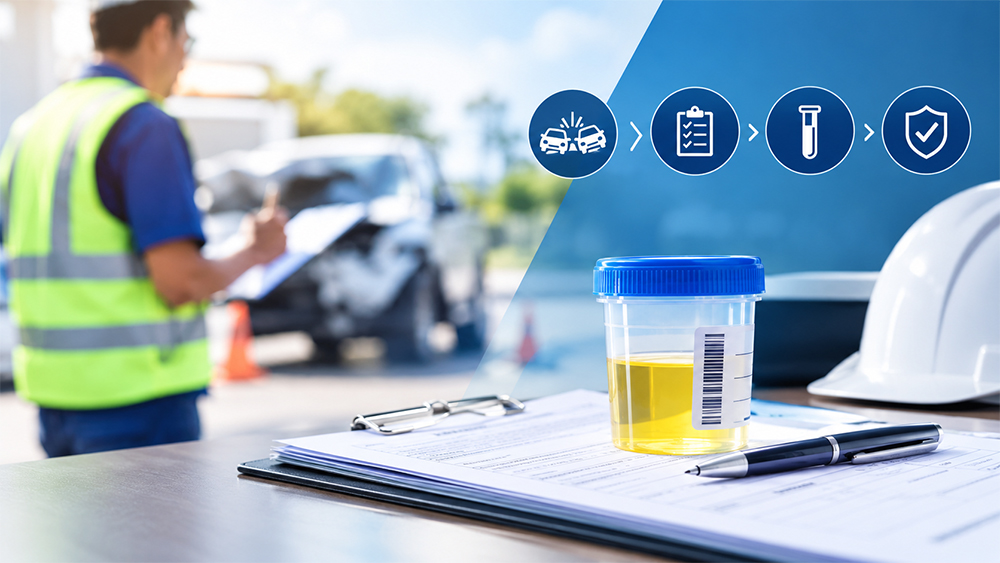
Incident occurs → Ensure immediate safety → Obtain medical care if necessary → Notify designated supervisor/HR → Determine whether testing criteria are met → Arrange appropriate testing → Document the process → Manage results confidentially.
This gives supervisors a repeatable process rather than requiring them to make decisions under pressure.
Step 2: Prioritize Safety and Medical Treatment
Drug testing should never interfere with emergency medical care.
If an employee is injured, the employer’s first priority should be obtaining appropriate medical attention and securing the incident scene.
For example, an employee involved in a serious machinery accident may need immediate emergency treatment. Sending that employee to a collection facility before receiving necessary medical care could create additional safety risks.
Once the employee is medically stable and able to participate in testing, the employer can proceed according to its policy and applicable requirements.
Employers should also understand that the timing and circumstances surrounding specimen collection can affect the usefulness and compliance of the testing process.
Step 3: Determine Whether Federal or State Rules Apply
A post-incident drug testing procedure should not be designed around a one-size-fits-all rule.
Different requirements can apply depending on:
- Industry
- Employee position
- Whether the employee performs DOT-regulated safety-sensitive functions
- State law
- Local requirements
- Employer policy
- Collective bargaining agreements
- Applicable federal regulations
DOT-regulated employees
Employers operating under DOT regulations must follow the applicable requirements established by the employee’s DOT operating agency.
For example, FMCSA-regulated employers have specific requirements governing post-accident testing.
A company should therefore determine whether the employee and incident meet the applicable regulatory criteria before ordering a DOT post-accident test.
Do not use a general non-DOT post-incident process as a substitute for a required DOT test.
Step 4: Establish a Clear Decision-Making Process
A supervisor should not have to guess whether an incident qualifies for testing.
Designate specific individuals or roles responsible for making the decision.
Depending on the organization, this may include:
- Safety manager
- HR manager
- Designated company official
- Drug and alcohol program manager
- DER for DOT-regulated programs
Create an incident-testing checklist that captures:
- Date and time of incident
- Location
- Employee involved
- Job position
- Description of the incident
- Injuries or medical treatment
- Property damage
- Witness information
- Whether the employee was performing safety-sensitive duties
- Applicable testing policy
- Reason testing was initiated
- Person authorizing the test
- Time the employee was notified
- Time the collection was completed or attempted
Documentation should describe observable facts rather than unsupported conclusions about whether an employee was impaired.
Step 5: Arrange Testing as Quickly as Practicable
Once testing is determined to be appropriate, employers should have a reliable process for arranging the collection.
A strong post-incident program should provide access to:
- Drug testing collection locations
- After-hours testing options when needed
- DOT and non-DOT testing
- Appropriate specimen types
- Chain-of-custody documentation
- Result reporting
- Employer support when a collection issue occurs
For organizations operating around the clock, after-hours incidents can create a major logistical challenge.
An employee may be involved in an incident at 2:00 a.m., when a traditional collection facility is closed.
Employers should establish an after-hours post-incident testing procedure before an emergency occurs.
Step 6: Use the Correct Test and Testing Authority
Employers should clearly distinguish between DOT and non-DOT testing.
A DOT test must use the applicable DOT procedures and forms. A non-DOT test is governed by the employer’s policy and applicable federal/state requirements.
The testing order should accurately identify:
- Employee information
- Employer information
- DOT or non-DOT status
- Drug panel
- Specimen type
- Testing reason
- Required alcohol testing, when applicable
- Other program-specific requirements
For alcohol testing, employers should also make sure they are using the appropriate testing procedure and qualified personnel when the applicable program requires it.
Step 7: Protect the Chain of Custody
Chain of custody is a critical component of workplace drug testing.
It provides documentation showing how the specimen was collected, handled, transferred, tested, and reported.
A compliant collection process should include appropriate identification and documentation, specimen security, and controlled transfer of the specimen.
Employers should work with qualified collection and laboratory providers that follow the applicable testing standards.
Employees should also be instructed to follow collection-site procedures carefully.
Step 8: Train Supervisors Before an Incident Happens
A post-incident procedure is only useful if supervisors know how to execute it.
Supervisors should receive training covering:
- When the post-incident policy may apply
- How to secure the incident area
- When emergency medical care takes priority
- Who must be contacted
- How to document observable facts
- How to contact the testing provider
- Employee notification procedures
- Confidentiality requirements
- DOT-specific responsibilities, where applicable
- What supervisors should and should not say about test results
Training should be refreshed periodically, especially when company policies or applicable regulations change.
Step 9: Address Timing Requirements
Timing can be one of the most important parts of a post-incident testing procedure.
Employers should not simply write “test as soon as possible” and leave supervisors without operational instructions.
Instead, create a process that answers:
Who calls the testing provider?
Who transports or directs the employee to the collection site?
What happens after normal business hours?
What happens if the employee is receiving medical treatment?
What happens if the employee cannot immediately provide a specimen?
Who documents delays?
For DOT programs, employers should follow the specific timing and documentation requirements applicable to the test.
For example, FMCSA rules contain specific post-accident testing requirements and time limits. Employers should consult the current applicable regulation rather than relying on an informal interpretation of the rule.
Step 10: Document Any Delay or Inability to Test
Not every post-incident test will happen immediately.
Possible complications include:
- Emergency medical treatment
- Hospitalization
- Employee transportation problems
- Closed collection facilities
- Inability to locate an available collector
- Employee refusal
- Other circumstances outside the employer’s control
When testing is delayed or cannot be completed, document what happened.
A good record should include:
- What occurred
- When it occurred
- Who was contacted
- What steps were taken
- Why testing could not be completed
- Any follow-up actions
For regulated employers, required documentation should follow the applicable regulatory requirements.
Step 11: Handle Refusals According to the Applicable Policy
An employee may refuse to participate in a required drug or alcohol test.
Employers should avoid improvising a response.
Instead, the employer’s written policy should explain:
- What constitutes a refusal
- Who must be notified
- How the refusal is documented
- What employment consequences may apply
- What regulatory requirements apply to regulated employees
DOT-regulated employers must follow the applicable DOT definition and procedures concerning a refusal to test.
A supervisor should document objective facts rather than making unsupported accusations.
Step 12: Keep Test Results Confidential
Drug and alcohol testing information is sensitive employment information.
Access should be limited to individuals with a legitimate business or regulatory need to know.
Employers should establish procedures for:
- Receiving results
- Storing results
- Restricting access
- Communicating results
- Maintaining required records
- Responding to employee questions
Supervisors generally should not have unrestricted access to an employee’s testing information.
Instead, they should receive only the information necessary to perform their responsibilities.
Step 13: Understand That a Positive Test is Not Automatically Proof of Workplace Impairment
One of the most important concepts for employers is the difference between a test result and a conclusion about impairment at the time of an incident.
A laboratory drug test can identify the presence of a substance or its metabolite according to the testing method and cutoff levels. The result does not necessarily establish exactly when the substance was used or whether the employee was impaired at the time of the incident.
Employers should therefore avoid making conclusions that go beyond what the testing program is designed to establish.
For DOT testing, the required Medical Review Officer process and applicable DOT procedures must be followed.
Step 14: Establish a Post-Result Process
Your policy should explain what happens after the test.
Negative result
The employer follows its normal return-to-work and incident-review procedures.
Non-negative or positive result
The employer follows the applicable confirmation, review, notification, and employment procedures.
Refusal
The employer follows its written policy and applicable regulatory requirements.
Step 15: Review Your Procedure Regularly
Workplace drug testing requirements can change.
Employers should periodically review their procedures against:
- Federal regulations
- State laws
- DOT requirements
- Company policy
- Insurance requirements
- Collective bargaining agreements, where applicable
- Testing provider procedures
A periodic review can identify outdated language, incorrect forms, missing after-hours procedures, or gaps in supervisor training.
Post-Incident Drug Testing Checklist for Employers
| Procedure | Completed? |
|---|---|
| Written post-incident testing policy | ☐ |
| Objective testing triggers defined | ☐ |
| DOT vs. non-DOT requirements identified | ☐ |
| State-law requirements reviewed | ☐ |
| Designated decision-maker identified | ☐ |
| Supervisor training completed | ☐ |
| Emergency medical procedure established | ☐ |
| Collection locations identified | ☐ |
| After-hours testing procedure established | ☐ |
| Chain-of-custody process documented | ☐ |
| Employee notification procedure established | ☐ |
| Refusal procedure documented | ☐ |
| Confidential result-handling process established | ☐ |
| Documentation requirements established | ☐ |
| Positive-result/MRO process documented | ☐ |
| Periodic policy review scheduled | ☐ |
How Employers Can Build a 24/7 Post-Incident Testing Program
Organizations with employees working nights, weekends, or remote shifts need a process that works outside normal office hours.
A practical program can include:
1. Employer activation
The employer registers for post-incident testing support and establishes authorized contacts.
2. Incident occurs
The supervisor follows the company’s safety and incident-response procedures.
3. Testing decision
The designated company representative determines whether testing is appropriate under the applicable policy and regulations.
<strong>4. Testing request
The employer contacts its testing provider and provides the required employee and incident information.
5. Collection arranged
The employee is directed to an appropriate collection facility or, where available and appropriate, an authorized after-hours collector is dispatched.
6. Documentation
The employer documents the incident, testing decision, timing, and any complications.
7. Laboratory/MRO process
The specimen follows the applicable laboratory and review procedures.
8. Results
Results are provided through the established confidential reporting process.
This type of workflow allows employers to respond to incidents without creating a new process from scratch every time an accident occurs.
Final Takeaway
A compliant post-incident drug testing program is not simply a drug test ordered after an accident.
It is a documented process that connects incident response, safety, testing criteria, regulatory requirements, specimen collection, chain of custody, result handling, confidentiality, and follow-up actions.
Employers can make the process more consistent by establishing clear testing triggers, training supervisors, identifying collection resources in advance, separating DOT and non-DOT procedures, documenting delays, and maintaining a reliable after-hours testing process.
Need Post-Incident Drug Testing Support?
US Health Testing helps employers coordinate workplace drug and alcohol testing through laboratory collection networks across the United States. Employers can arrange testing for workplace programs and establish procedures for situations that require timely testing.