DOT Clearinghouse Drug Testing Requirements: A Complete Guide for Employers
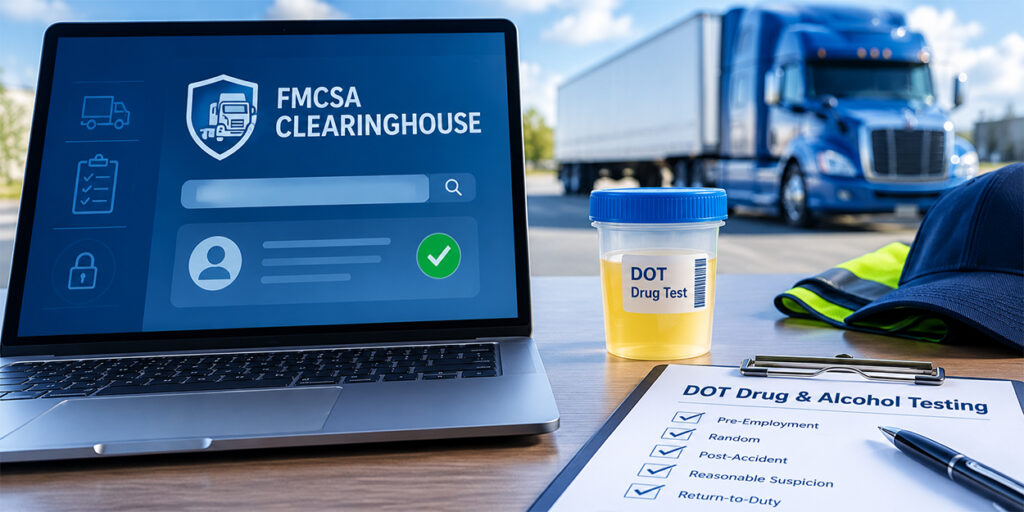
The FMCSA Drug & Alcohol Clearinghouse has become an essential part of DOT drug and alcohol compliance for motor carriers and employers of CDL drivers. While the Clearinghouse does not replace DOT drug and alcohol testing, it adds an important electronic record-checking and reporting requirement to the employer’s compliance program.
For employers covered by 49 CFR Part 382, understanding when to conduct Clearinghouse queries, what type of query to use, how driver consent works, and how Clearinghouse violations affect employment is critical.
This guide explains the key DOT Clearinghouse drug testing requirements employers need to know.
What Is the DOT Drug & Alcohol Clearinghouse?
The FMCSA Drug & Alcohol Clearinghouse is a secure federal database containing information about CDL drivers’ violations of the DOT drug and alcohol testing program.
Employers use the Clearinghouse to determine whether a prospective or current CDL driver is prohibited from performing safety-sensitive functions because of an unresolved DOT drug or alcohol program violation.
A Clearinghouse query is not itself a drug test. Instead, it is an electronic check of a driver’s Clearinghouse record.
Employers still need to conduct required DOT drug and alcohol tests under 49 CFR Part 40 and Part 382.
Who Must Comply With Clearinghouse Requirements?
Clearinghouse requirements generally apply to employers of CDL drivers who are subject to the FMCSA drug and alcohol testing requirements under Part 382.
This includes motor carriers employing drivers who operate commercial motor vehicles in safety-sensitive positions and are subject to DOT drug and alcohol testing.
Owner-operators also have Clearinghouse responsibilities. FMCSA notes that owner-operators must work with a consortium/third-party administrator (C/TPA) to manage their DOT drug and alcohol testing program.
What Are the DOT Clearinghouse Drug Testing Requirements?
For employers, the most important requirements include:
- Conduct a pre-employment Clearinghouse query before hiring a CDL driver into a safety-sensitive position.
- Conduct a Clearinghouse query at least once every 12 months for each current CDL driver.
- Obtain the appropriate driver consent before conducting a query.
- Conduct a full query for pre-employment screening.
- A limited query can satisfy the annual query requirement.
- Report certain DOT drug and alcohol violations to the Clearinghouse.
- Follow the required return-to-duty (RTD) process when a driver has a violation.
- Maintain appropriate documentation of your compliance activities.
Let’s look at each requirement in detail.
1. Pre-Employment Clearinghouse Query
Before employing a CDL driver in a safety-sensitive position, an employer must conduct a pre-employment query in the Clearinghouse.
The purpose is to determine whether the prospective employee has a drug or alcohol program violation that prohibits them from performing safety-sensitive functions.
All pre-employment queries must be full queries. A full query provides detailed information about a driver’s Clearinghouse record and requires the driver’s specific electronic consent through the Clearinghouse.
Example
A trucking company is hiring a new CDL driver.
Before allowing that driver to perform safety-sensitive work, the employer should:
Step 1: Obtain the driver’s required information.
Step 2: Send the driver a Clearinghouse consent request.
Step 3: Wait for the driver to provide electronic consent.
Step 4: Conduct the full pre-employment query.
Step 5: Review the result.
If the driver is not prohibited, the employer can continue the hiring process, subject to all other applicable DOT requirements.
2. Annual Clearinghouse Queries
Employers must conduct a Clearinghouse query at least once every year for every CDL driver they employ who is subject to the Part 382 requirements.
The annual requirement operates on a rolling 12-month basis.
For example:
- Driver A’s query: January 10, 2026
- Next query due: within the applicable 12-month period
- Driver B’s query: March 20, 2026
- Driver B’s next annual query is based on that driver’s query cycle.
Employers should maintain a tracking system rather than relying on a single calendar-year deadline.
Important
A pre-employment query can satisfy the annual query requirement for that driver. The employer does not need to immediately perform another query simply because the driver has been hired.
3. Limited vs. Full Clearinghouse Queries
One of the most common sources of confusion is the difference between limited queries and full queries.
| Query Type | Primary Use | Driver Consent |
|---|---|---|
| Full Query | Pre-employment screening and obtaining detailed violation information | Specific electronic consent |
| Limited Query | Annual verification | General consent outside Clearinghouse |
| Follow-up Full Query | Investigating information identified through a limited query | Specific electronic consent |
Full Query
A full query provides detailed information about violations in a driver’s Clearinghouse record.
A full query is required for pre-employment screening.
Limited Query
A limited query determines whether there is information recorded in the driver’s Clearinghouse record.
It can satisfy the annual query requirement when the appropriate general consent has been obtained.
If a limited query indicates that information exists, the employer must conduct a full query to access the details.
4. Driver Consent Is Required
Employers cannot simply access a driver’s Clearinghouse record without the required consent.
For a full query, the driver provides specific electronic consent through the Clearinghouse.
For a limited query, the employer can obtain general consent outside the Clearinghouse, including written consent. FMCSA indicates that this general consent may be valid for multiple years.
What Happens if a Driver Refuses Consent?
If a driver refuses the required consent for an employer’s query, the employer cannot verify the driver’s Clearinghouse status.
According to FMCSA, the driver cannot perform safety-sensitive functions for that employer when the required query cannot be completed because the driver did not provide consent.
5. What Does a Clearinghouse Violation Mean?
A driver may have a Clearinghouse record because of certain DOT drug and alcohol program violations.
Examples include:
- A verified positive DOT drug test
- A confirmed alcohol result of 0.04 or higher
- A refusal to submit to a required DOT drug or alcohol test
- Certain instances of employer actual knowledge
- Other reportable violations under the applicable regulations
FMCSA identifies specific violation and RTD information that employers, MROs, and SAPs must report.
A driver with an unresolved violation may be prohibited from performing safety-sensitive functions.
6. What Happens After a Positive DOT Drug Test?
A positive DOT drug test can trigger several compliance steps.
The employer should not simply treat it as an ordinary workplace drug test result.
Depending on the circumstances, the process can involve:
- MRO verification of the drug test result.
- Reporting of the violation to the Clearinghouse.
- Removal of the driver from safety-sensitive functions.
- Referral to a qualified Substance Abuse Professional (SAP).
- Completion of the required education or treatment.
- SAP follow-up evaluation.
- Return-to-duty testing.
- Follow-up testing according to the SAP’s plan.
- Required Clearinghouse reporting.
A driver with a verified violation is prohibited from performing safety-sensitive functions until the applicable RTD requirements are satisfied.
7. Return-to-Duty Testing and the Clearinghouse
The Clearinghouse is closely connected to the DOT return-to-duty process.
When a driver has a DOT drug or alcohol violation, the driver must complete the applicable Substance Abuse Professional (SAP) process before becoming eligible for return-to-duty testing.
The general process includes:
Violation → SAP evaluation → Education/Treatment → SAP follow-up evaluation → RTD eligibility → Return-to-duty test → Follow-up testing
The driver can return to safety-sensitive functions after the applicable requirements have been completed and the required return-to-duty test has a negative result.
Employers must also manage the required follow-up testing plan.
8. Who Reports Information to the Clearinghouse?
Different participants in the DOT testing process have different reporting responsibilities.
For example:
Medical Review Officers
MROs report certain verified drug violations.
Employers
Employers or their designated C/TPAs report applicable employer-reportable violations and certain return-to-duty information.
Substance Abuse Professionals
SAPs report required information related to the driver’s SAP evaluation and eligibility for return-to-duty testing.
FMCSA specifies the information each party must report under the Clearinghouse regulations.
9. Clearinghouse Query Notifications
Employers should also pay attention to Clearinghouse notifications after completing queries.
FMCSA states that, following a query, employers may receive notification if new information is added to the driver’s Clearinghouse record within the applicable 12-month period.
This means employers should not treat the Clearinghouse as a one-time hiring check.
The employer’s compliance process should include:
Query → Monitor notifications → Investigate required changes → Take appropriate action
10. Clearinghouse Query Plans
Employers must have a query plan to conduct Clearinghouse queries.
FMCSA explains that employers are charged for Clearinghouse queries and must purchase a query plan. A C/TPA cannot purchase the query plan on behalf of the employer.
Employers should select a query plan that accommodates the number of CDL drivers they need to query.
DOT Clearinghouse vs. DOT Drug Testing: What’s the Difference?
This distinction is extremely important.
| DOT Drug Testing | Clearinghouse |
|---|---|
| Collects and analyzes a specimen | Checks a driver’s federal violation record |
| Urine/oral-fluid testing may apply depending on the DOT program and current rules | Electronic database query |
| Identifies drug/alcohol test results | Identifies reportable violations and driver status |
| Conducted through qualified collection/testing processes | Conducted through the FMCSA Clearinghouse |
| Includes pre-employment, random, post-accident, reasonable suspicion, return-to-duty, etc. | Includes pre-employment and annual queries plus required reporting |
The Clearinghouse does not replace DOT drug testing.
An employer can be compliant with its drug testing schedule and still have a Clearinghouse compliance problem if required queries or reporting are missed.
Employer DOT Clearinghouse Compliance Checklist
Use this checklist to help manage your program:
Before Hiring a CDL Driver
- Confirm the position is subject to FMCSA/DOT drug and alcohol testing.
- Register/manage your employer Clearinghouse account.
- Obtain required driver information.
- Send the driver the electronic consent request.
- Complete a full pre-employment Clearinghouse query.
- Confirm the driver is not prohibited.
- Complete the required DOT pre-employment drug test and other applicable requirements.
- Maintain required records.
For Current CDL Drivers
- Track each driver’s annual Clearinghouse query date.
- Conduct the required query at least once every 12 months.
- Maintain appropriate general consent for limited queries.
- Investigate any indication of Clearinghouse information.
- Conduct a full query when required.
- Monitor Clearinghouse notifications.
- Maintain documentation.
After a DOT Violation
- Remove the driver from safety-sensitive functions when required.
- Complete applicable Clearinghouse reporting.
- Provide information regarding the SAP process.
- Complete the return-to-duty process.
- Conduct the required return-to-duty test.
- Follow the SAP’s follow-up testing plan.
- Complete required Clearinghouse reporting.
Common DOT Clearinghouse Mistakes Employers Make
Mistake 1: Treating the Clearinghouse as a Drug Test
The Clearinghouse is a federal database. It does not replace the actual DOT drug and alcohol testing program.
Mistake 2: Forgetting Annual Queries
An employer may complete a pre-employment query and then forget that current drivers must continue to be queried at least annually.
Mistake 3: Using a Limited Query for Pre-Employment
Pre-employment queries must be full queries.
Mistake 4: Not Obtaining Driver Consent
The appropriate consent must be obtained before accessing the driver’s Clearinghouse information.
Mistake 5: Assuming a Positive Test Automatically Ends Employment
A DOT violation creates specific compliance obligations. Employers should follow the applicable DOT process rather than treating the situation solely as a standard HR disciplinary matter.
Mistake 6: Failing to Track RTD and Follow-Up Requirements
A driver may complete the initial return-to-duty process but still have a follow-up testing plan that must be managed.
Can a C/TPA Manage Clearinghouse Requirements?
Yes. Employers can designate a consortium/third-party administrator (C/TPA) to conduct Clearinghouse queries on their behalf.
However, the employer remains responsible for ensuring its DOT program complies with applicable requirements.
For owner-operators, working with a C/TPA to manage the DOT drug and alcohol testing program is required.
A C/TPA can help employers manage:
- Clearinghouse queries
- DOT random testing
- Pre-employment testing
- Post-accident testing
- Reasonable-suspicion testing
- Return-to-duty testing
- Follow-up testing
- Compliance documentation
How Often Should CDL Drivers Be Queried in the Clearinghouse?
The simple answer is:
Before employment and at least once every 12 months while employed.
However, employers should also respond appropriately when the Clearinghouse indicates that additional information or a follow-up query is necessary.
The annual requirement is based on a rolling 365-day/12-month period rather than simply querying every driver once during a calendar year.
Final Takeaway for Employers
DOT Clearinghouse compliance should be treated as part of your overall DOT drug and alcohol compliance program, not as a separate administrative task.
For most employers, the core process is:
Hire CDL driver → Full pre-employment Clearinghouse query → DOT pre-employment testing → Employ driver → Annual Clearinghouse query → Continue DOT testing program → Report applicable violations → Manage RTD/follow-up requirements when necessary.
Having a documented process for Clearinghouse queries, DOT drug testing, consent, annual tracking, violation reporting, and return-to-duty testing can help employers avoid preventable compliance problems.
Important: DOT and FMCSA requirements can change. Employers should verify current requirements in the applicable FMCSA regulations and official Clearinghouse guidance before making compliance decisions.