Workplace Drug Testing for EHS Professionals: A Complete Guide to Safety, Compliance and Prevention
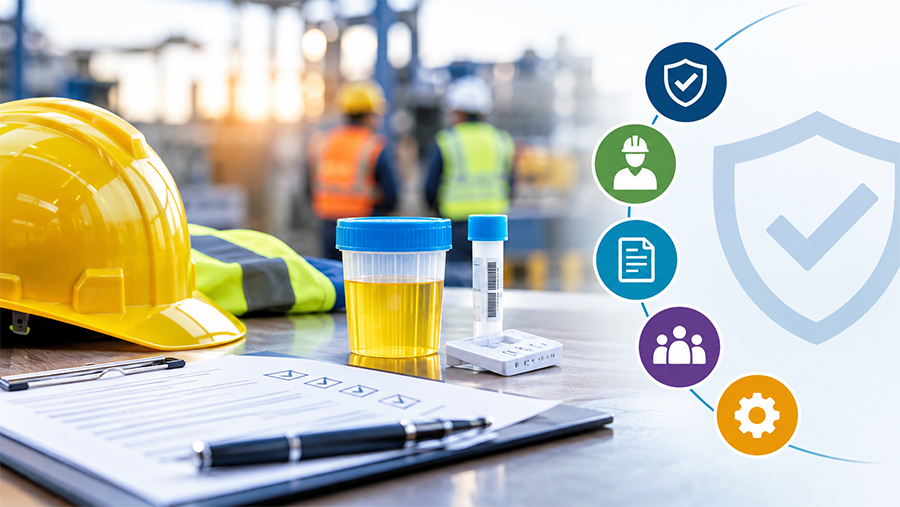
Workplace safety requires more than protective equipment, safety training, and hazard assessments. It also requires employers to identify human factors that can contribute to incidents, including impairment, fatigue, and reduced judgment. In construction, manufacturing, transportation, warehousing, and other safety-sensitive industries, these factors can create serious risks for employees and the public.
For Environmental, Health, and Safety (EHS) professionals, workplace drug testing can be an important component of a comprehensive safety program. When implemented appropriately, it can support risk management, reinforce workplace policies, and help organizations meet applicable regulatory requirements.
However, testing alone cannot prevent every incident. Effective programs combine clear policies, consistent procedures, employee education, confidentiality protections, and proactive hazard management.
This guide explains how EHS professionals can develop a workplace drug testing program that prioritizes safety, supports compliance, and strengthens prevention across their organizations.
Why Workplace Drug Testing Matters for EHS Professionals
EHS professionals are responsible for identifying hazards, evaluating risks, investigating incidents, and implementing corrective actions. Substance-related impairment can increase risks when employees operate heavy machinery, drive commercial vehicles, handle hazardous materials, or perform tasks requiring concentration and coordination.
A well-designed workplace drug testing program can support these responsibilities by:
- Supporting risk management: Establishing procedures for addressing potential substance-related safety concerns.
- Reinforcing workplace policies: Communicating expectations regarding substance use and fitness for duty.
- Meeting regulatory requirements: Helping employers comply with applicable testing rules for covered employees.
- Supporting incident investigations: Providing relevant testing information when testing is required or justified.
- Promoting accountability: Applying consistent procedures across covered employees and job classifications.
Drug testing should not be viewed as proof that an employee was impaired. A positive result may indicate substance exposure within a particular detection window, while a negative result does not guarantee that someone is fit for duty.
The goal is to use testing responsibly as one part of a broader strategy to reduce workplace hazards.
Understanding Drug Testing and Workplace Impairment
One of the most important responsibilities of EHS professionals is understanding what a drug test can and cannot establish.
Drug tests analyze biological specimens for specified substances or their metabolites. The detection window depends on the substance, specimen type, testing method, and individual circumstances.
For example, urine testing may detect substances after their immediate effects have diminished. Hair testing can provide information about exposure over a longer retrospective period, while oral fluid testing has different detection characteristics.
A positive result does not necessarily establish when a substance was used, whether the employee was impaired during a specific task, or whether substance use contributed to an incident.
Similarly, a negative result cannot establish that an employee is free from every substance-related risk.
EHS professionals should distinguish among three questions:
- Was a specified substance detected?
- Was the employee impaired at the relevant time?
- Could the employee safely perform the assigned work?
These questions require different types of evidence and assessment. Testing results should be interpreted alongside relevant observations, incident circumstances, and applicable fitness-for-duty procedures.
Establishing a Written Workplace Drug Testing Policy
A written policy provides the foundation for a consistent and legally informed testing program. EHS professionals should collaborate with HR, legal counsel, occupational health providers, and operational managers to develop procedures that reflect actual workplace risks.
Define the Purpose and Scope
Start by identifying why the organization needs drug testing. Reasons may include regulatory compliance, safety-sensitive job responsibilities, customer requirements, or enforcement of an established workplace policy.
Clearly identify the employees covered, the applicable testing circumstances, and any differences between regulated and non-regulated positions.
For example, an employer with commercial drivers covered by U.S. Department of Transportation regulations must distinguish DOT testing from additional company testing. The procedures and legal requirements may differ.
Identify When Testing May Occur
Common workplace testing categories include:
- Pre-employment testing: Screening candidates at a stage permitted by applicable law and the employer’s policy.
- Random testing: Selecting employees through an appropriate random process where permitted or required.
- Reasonable-suspicion testing: Initiating testing based on specific observations and applicable policy criteria.
- Post-incident testing: Testing after qualifying events when required or appropriately justified.
- Return-to-duty testing: Testing under an applicable regulatory or authorized return-to-work process.
- Follow-up testing: Testing conducted under an applicable return-to-duty or workplace policy arrangement.
Not every category is appropriate for every employer. State laws may restrict certain testing practices, and DOT-covered employees must follow the requirements applicable to their regulated positions.
Explain Procedures and Consequences
Employees should understand which substances are included in the testing panel, how specimens are collected, how results are reviewed, and what happens following a verified result or policy violation.
The policy should also explain available employee assistance resources and the process for addressing medication-related safety concerns or accommodation requests.
Consistent implementation is essential. Employers should avoid assuming that every positive result proves workplace impairment or automatically warrants the same response regardless of the circumstances.
Understanding U.S. Workplace Drug Testing Regulations
Workplace drug testing in the United States is governed by federal regulations, state and local laws, employment protections, and industry-specific requirements.
There is no universal federal requirement for every private employer to test every employee. Requirements depend on the organization, job duties, applicable laws, and regulatory coverage. SAMHSA provides guidance on federal and non-federal workplace drug testing programs.
Department of Transportation Requirements
The U.S. Department of Transportation establishes drug and alcohol testing requirements for covered safety-sensitive employees in regulated transportation industries.
49 CFR Part 40 establishes procedures for DOT workplace drug and alcohol testing. Additional requirements come from the relevant operating administration, including the Federal Motor Carrier Safety Administration (FMCSA), Federal Aviation Administration (FAA), Federal Railroad Administration (FRA), Federal Transit Administration (FTA), and Pipeline and Hazardous Materials Safety Administration (PHMSA).
The exact requirements depend on the employee’s duties and the applicable regulation.
Covered employers must follow the relevant procedures for testing circumstances, collection, laboratory analysis, medical review, documentation, and recordkeeping. A general company policy cannot replace mandatory DOT procedures.
Employers should consult the official DOT guidance when developing or updating a regulated testing program.
OSHA and Post-Incident Drug Testing
OSHA requires employers to maintain appropriate workplace safety protections and prohibits retaliation against employees for reporting work-related injuries or illnesses.
Under 29 CFR 1904.35(b)(1)(iv), employers must not discriminate against employees for reporting workplace injuries or illnesses. OSHA does not prohibit all post-incident drug testing, but testing should have a legitimate safety or regulatory basis.
For example, testing may be relevant when a worker’s conduct could reasonably have contributed to an incident involving heavy equipment. Automatically testing every employee who reports an injury, regardless of the circumstances, may discourage reporting and create compliance concerns.
EHS professionals should establish objective criteria for post-incident testing and investigate other possible contributing factors, including equipment failures, inadequate training, fatigue, and unsafe procedures.
State Laws and Employee Protections
State and local laws may impose requirements relating to advance notice, written policies, applicant screening, random testing, cannabis, privacy, and adverse employment decisions.
Employers operating in multiple states should review applicable laws for each location and maintain appropriate policy variations where necessary.
The Americans with Disabilities Act (ADA) and other employment protections may also affect how employers handle medical information, prescription medication concerns, and accommodation requests.
EHS professionals should coordinate with HR and legal counsel before making decisions involving confidential medical information or potentially protected circumstances.
Choosing the Appropriate Drug Testing Method
The right testing method depends on the program’s purpose, target substances, applicable regulations, detection window, and operational requirements.
Urine Drug Testing
Urine testing is widely used in workplace drug testing programs. It can detect specified substances or their metabolites within a method-dependent detection window.
Employers may use urine testing for pre-employment, random, reasonable-suspicion, post-incident, and other authorized testing.
However, urine results do not independently establish current impairment. Appropriate collection procedures, laboratory analysis, specimen validity checks, and result review are important to the integrity of the process.
Oral Fluid Drug Testing
Oral fluid testing analyzes a saliva-based specimen for specified substances or analytes. It offers a different collection process and detection window from urine testing.
EHS professionals should verify whether oral fluid testing is authorized for their particular program. Employers must not assume that every commercially available test satisfies DOT or other regulated testing requirements.
Hair Drug Testing
Hair testing can provide retrospective information about exposure over a longer period than many urine or oral fluid tests. It may be appropriate for certain non-DOT employer programs when permitted by applicable law and consistent with the organization’s policy.
Hair testing is generally not suitable for establishing current impairment or determining whether a worker was impaired at the precise time of an incident.
Laboratory-Based Alcohol Testing
Laboratory-based alcohol testing can complement a workplace drug testing program when appropriate and permitted by applicable rules.
Urine ethyl glucuronide (EtG) testing can help identify alcohol exposure within a method-dependent detection window. Hair EtG testing may provide information about alcohol exposure over a longer retrospective period, depending on the sample and testing method.
Neither method independently establishes current intoxication, a person’s alcohol concentration at a specific time, or impairment during a workplace incident.
EHS professionals should select the method based on the intended purpose, laboratory capabilities, specimen requirements, and applicable regulations.
Managing Post-Incident Drug Testing
Post-incident testing requires a structured process that prioritizes employee welfare, evidence preservation, and compliance.
Step 1: Address immediate hazards. Arrange medical assistance, secure the scene, and prevent further harm. Testing must not delay necessary medical treatment.
Step 2: Document the incident. Record witness accounts, equipment conditions, work procedures, environmental conditions, and relevant observations.
Step 3: Determine whether testing is appropriate. Check regulatory requirements and the organization’s written policy. Consider whether substance use could reasonably have contributed to the incident.
Step 4: Arrange authorized collection. Use an appropriate collection provider and follow the required specimen handling, documentation, and chain-of-custody procedures.
Step 5: Review the results appropriately. Follow applicable laboratory and medical review procedures before making employment decisions.
Step 6: Complete the root-cause investigation. Examine equipment, training, staffing, fatigue, supervision, and other contributing factors rather than treating a test result as the conclusion.
For DOT-covered employees, the applicable agency’s post-accident criteria and deadlines must be followed.
Building a Prevention-Focused Safety Culture
An effective workplace drug testing program should combine accountability with prevention and employee support.
Train Supervisors
Supervisors should understand how to recognize and document observable safety concerns without attempting to diagnose drug use.
Unusual coordination, disorientation, changes in behavior, or unsafe actions may justify further assessment, but these signs can also have other explanations. Supervisors should follow established escalation procedures and avoid unsupported accusations.
Educate Employees
Employees should understand workplace expectations, testing procedures, confidentiality protections, and the consequences of policy violations.
Education should explain how substance use and certain medications may affect alertness, coordination, reaction time, and judgment, while recognizing that individual effects vary.
Provide Access to Employee Assistance
Employee Assistance Programs (EAPs), where available, can help employees access support for substance-use concerns and other personal challenges that may affect work.
Employers should communicate available resources and explain the difference between voluntary assistance and any mandatory referral or follow-up process required by applicable policy or regulation.
Address Other Workplace Risk Factors
Fatigue, excessive overtime, poor staffing, inadequate training, and production pressure can also contribute to incidents. EHS professionals should evaluate these factors alongside substance-related concerns.
A prevention-focused program addresses the underlying hazards rather than relying exclusively on testing or disciplinary measures.
Protecting Confidentiality and Maintaining Reliable Records
Drug testing involves sensitive information. Employers should restrict access to authorized personnel, use secure systems, and communicate results through approved channels.
Testing providers should have appropriate qualifications for the intended program. Employers should also verify laboratory requirements, confirmatory testing procedures, and the role of a Medical Review Officer (MRO) where applicable.
An MRO is a licensed physician who reviews and interprets drug testing results under the relevant program. The MRO may evaluate legitimate medical explanations in accordance with applicable procedures.
Records should be retained for the periods required by relevant regulations and policies. Employers should avoid unnecessary disclosure of individual results and ensure that supervisors receive only the information needed to manage workplace safety.
SAMHSA provides resources on laboratory certification, specimen collection, medical review, and confidential recordkeeping.
Measuring Program Effectiveness
EHS professionals should evaluate whether the testing program contributes to effective risk management and continuous improvement.
Useful indicators include:
- Workplace injury and illness trends.
- Serious incidents and near misses.
- Completion of required testing.
- Supervisor training completion.
- Testing procedure audit results.
- Time taken to complete incident investigations.
- Corrective-action closure rates.
- Employee awareness of policies and available support.
Testing positivity rates may provide additional information, but they should not be treated as a direct measure of impairment or workplace safety. Results must be interpreted in context, with appropriate privacy safeguards.
Regular program reviews help identify procedural gaps, changing workplace risks, and opportunities to improve prevention.
Conclusion
Workplace drug testing can be a valuable component of an EHS program when it is designed around legitimate safety objectives, implemented consistently, and aligned with applicable regulations.
For EHS professionals, success means more than selecting a test or responding to a positive result. It means establishing clear policies, training supervisors, protecting employee confidentiality, investigating incidents objectively, and addressing the underlying conditions that contribute to workplace hazards.
By integrating appropriate testing with hazard controls, employee education, fatigue management, and access to support resources, organizations can strengthen their safety culture and make better-informed decisions.
The ultimate objective is to create a workplace where employees understand their responsibilities, risks are identified early, incidents are investigated fairly, and prevention remains the priority.