
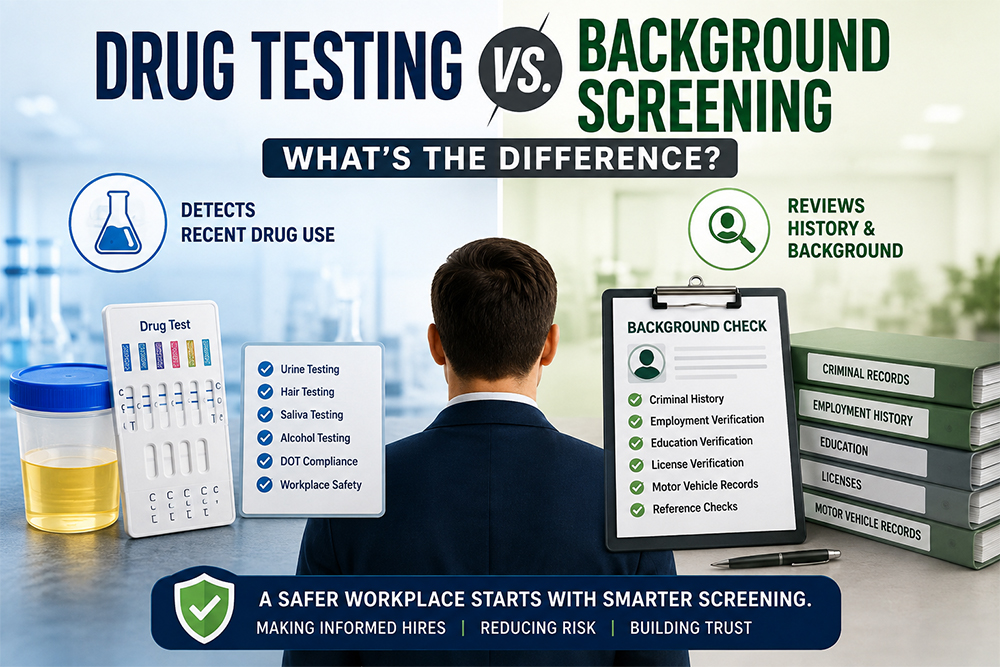
Drug Testing vs. Background Screening: What’s the Difference?
Hiring the right employees is one of the most important decisions an employer can make. A poor hiring decision can lead to workplace accidents, productivity loss, legal liability, theft, increased turnover, and damage to your company’s reputation.
To reduce hiring risks, employers commonly use drug testing and background screening. While these two processes are often mentioned together, they serve entirely different purposes.
Many employers mistakenly believe that a background check includes drug testing—or vice versa. In reality, they are separate screening services that provide different types of information about a job candidate or employee.
This guide explains:
- What drug testing is
- What background screening is
- The major differences
- When employers should use each
- Industries that require both
- Legal compliance considerations
- Best practices for implementing an effective screening program
Whether you manage a small business or a nationwide workforce, understanding these differences will help you make smarter hiring decisions.
What Is Drug Testing?
Drug testing is the process of analyzing biological specimens to determine whether an individual has recently used illegal drugs or certain prescription medications.
Unlike background screening, drug testing evaluates current or recent substance use, not a person’s past history.
Employers commonly use laboratory-certified drug testing to:
- Maintain workplace safety
- Reduce accidents
- Meet DOT requirements
- Comply with company drug-free workplace policies
- Lower workers’ compensation claims
- Reduce absenteeism
- Improve productivity
Common Types of Drug Tests
Urine Drug Testing
The most widely used workplace drug test.
Advantages include:
- Cost-effective
- Fast turnaround
- Widely accepted
- Detects recent drug use
- DOT-approved
Commonly used for:
- Pre-employment
- Random testing
- Post-accident testing
- Reasonable suspicion testing
Hair Drug Testing
Hair testing provides a much longer detection window.
Benefits include:
- Detects drug use up to approximately 90 days
- Difficult to tamper with
- Excellent for identifying repeated drug use
Often used for:
- Executive hiring
- Safety-sensitive positions
- High-security jobs
Oral Fluid (Saliva) Testing
Saliva testing detects very recent drug use.
Advantages include:
- Easy collection
- Observed collection reduces cheating
- Ideal after workplace incidents
Instant Drug Tests
Rapid screening tests provide preliminary results within minutes.
Positive instant tests generally require laboratory confirmation.
What Does Drug Testing Detect?
Drug testing typically identifies substances such as:
- Marijuana (THC)
- Cocaine
- Amphetamines
- Methamphetamine
- Opiates
- PCP
- Benzodiazepines
- Barbiturates
- Oxycodone
- Methadone
- Synthetic opioids
- Fentanyl (when included)
- Alcohol (depending on the test)
Panels may range from 5-panel to 18-panel drug tests depending on employer requirements.
What Is Background Screening?
Background screening is the process of verifying a candidate’s identity, qualifications, employment history, education, criminal history, and other relevant records.
Rather than determining recent drug use, background checks help employers understand whether an applicant has represented themselves accurately and whether there are any issues that may affect hiring decisions.
Background screening helps employers verify trustworthiness, qualifications, and potential risks.
What Does a Background Check Include?
Depending on the employer and position, a background screening may include:
Criminal History
Searches may include:
- County criminal records
- State criminal records
- Federal criminal records
- Sex offender registry
- Global watch lists
Employment Verification
Confirms:
- Previous employers
- Job titles
- Employment dates
- Work history
Education Verification
Verifies:
- Degrees
- Diplomas
- Certifications
- Schools attended
Professional License Verification
Important for:
- Healthcare professionals
- Engineers
- Financial professionals
- Commercial drivers
- Teachers
Identity Verification
Confirms:
- Name
- Social Security trace (where legally applicable)
- Address history
- Date of birth
Motor Vehicle Records (MVR)
Essential for employees who drive company vehicles.
Includes:
- Driver’s license status
- Violations
- Suspensions
- Accident history
Credit Reports
For certain financial positions, employers may review credit history where permitted by law.
Reference Checks
Employers may contact previous supervisors or references to verify:
- Performance
- Attendance
- Professional conduct
Drug Testing vs. Background Screening
| Feature | Drug Testing | Background Screening |
|---|---|---|
| Purpose | Detects recent drug or alcohol use | Reviews candidate history and qualifications |
| Focus | Current or recent substance use | Past records and identity verification |
| Sample Required | Urine, hair, saliva, blood, or breath | No biological sample required |
| Criminal History | No | Yes |
| Employment Verification | No | Yes |
| Education Verification | No | Yes |
| Driving Record | No | Yes |
| Detects Illegal Drug Use | Yes | No |
| Detects Prescription Drug Use (when applicable) | Yes | No |
| Used for DOT Compliance | Yes | Sometimes (MVR may be included) |
| Collection Required | Yes | No |
Can a Background Check Show Drug Test Results?
No.
A standard employment background check does not reveal previous drug test results.
Drug testing records are generally confidential medical information and are not included in criminal background reports.
If an employer wants to determine whether a candidate is currently using drugs, they must order a separate drug test.
Can Drug Testing Reveal Criminal Records?
No.
Drug testing only identifies the presence (or absence) of specific drugs or alcohol.
It does not reveal:
- Arrest records
- Convictions
- Warrants
- Employment history
- Education
- Financial history
These require a separate background screening.
Why Employers Often Use Both
Many employers combine drug testing with background screening because together they provide a more complete picture of a candidate.
Drug testing evaluates current workplace safety risks, while background screening verifies a candidate’s history and qualifications.
Using both helps employers:
- Hire qualified employees
- Improve workplace safety
- Reduce negligent hiring risks
- Minimize theft and fraud
- Lower turnover
- Protect company reputation
- Meet customer and regulatory requirements
Industries That Frequently Use Both
Construction
Construction companies often perform:
- Criminal background checks
- Pre-employment drug tests
- Random drug testing
These measures help reduce workplace accidents and support safety on active job sites.
Transportation
Commercial transportation employers commonly conduct:
- DOT-compliant drug testing
- Motor vehicle record checks
- Employment verification
These screenings help ensure compliance and safe operation of commercial vehicles.
Healthcare
Hospitals and healthcare organizations frequently verify:
- Professional licenses
- Criminal history
- Education credentials
- Drug-free status
Patient safety is a primary concern.
Manufacturing
Manufacturers often screen employees because machinery-related accidents can have serious consequences.
Common screenings include:
- Drug testing
- Criminal history
- Employment verification
Government Contractors
Government contractors may require:
- Extensive background investigations
- Drug testing
- Security clearance verification
- Identity verification
When Should Employers Conduct Drug Testing?
Employers commonly conduct testing during:
Pre-Employment
Before a candidate begins work.
Random Testing
Randomly selected employees are tested throughout the year according to company policy or regulatory requirements.
Post-Accident Testing
Following a workplace accident or safety incident to determine whether substance use may have been a contributing factor.
Reasonable Suspicion Testing
Performed when trained supervisors observe signs of possible impairment, such as unusual behavior, slurred speech, or coordination issues.
Return-to-Duty and Follow-Up Testing
Often required after a policy violation or as part of a return-to-duty process in regulated industries.
When Should Employers Conduct Background Screening?
Background screening is typically performed:
- Before extending a final job offer
- Prior to employee onboarding
- Before promotions into sensitive roles
- Before granting access to confidential information
- When employees transfer into security-sensitive positions
- Periodically for certain regulated industries where allowed by law
Legal Considerations for Employers
Employers should ensure that both drug testing and background screening programs comply with applicable federal, state, and local laws.
Best practices include:
- Obtain written consent before screening.
- Use consistent screening standards for similar job roles.
- Maintain confidentiality of screening results.
- Partner with accredited laboratories and reputable screening providers.
- Follow applicable adverse action procedures when using background reports.
- Keep records securely and limit access to authorized personnel.
- Train hiring managers on company screening policies.
Because laws vary by jurisdiction, employers should review applicable requirements with legal counsel or compliance professionals.
Best Practices for Employers
An effective screening program should include:
Develop Written Policies
Clearly explain:
- Who is tested
- When testing occurs
- Consequences of policy violations
Apply Policies Consistently
Treat similarly situated applicants and employees consistently to reduce legal risk.
Work With Certified Laboratories
Laboratory-confirmed drug testing provides reliable, defensible results.
Use Comprehensive Background Checks
Verify identity, employment, education, criminal history, and other relevant records based on the position.
Document Every Step
Maintain proper documentation for:
- Consent forms
- Test results
- Background reports
- Hiring decisions
- Compliance records
Final Thoughts
Drug testing and background screening are complementary—not interchangeable—tools in the hiring process. Drug testing helps employers identify recent substance use that could impact workplace safety, while background screening verifies a candidate’s history, credentials, and suitability for the role.
For organizations focused on reducing hiring risk, improving safety, and maintaining compliance, using both services together can provide a more comprehensive view of prospective employees. By implementing consistent policies, partnering with trusted screening providers, and following applicable laws, employers can build a safer, more reliable workforce.
Frequently Asked Questions
Is drug testing the same as a background check?
No. Drug testing detects recent substance use, while a background check verifies a person’s identity, qualifications, employment history, criminal records, and other relevant information.
Which should employers perform first?
Many employers initiate both processes after making a conditional job offer, subject to applicable laws and company policy. Timing may vary depending on the role and jurisdiction.
Can someone pass a background check but fail a drug test?
Yes. Background screening and drug testing measure different things. A candidate may have a clean background but still test positive for prohibited substances.
Does a failed drug test appear on a background check?
No. Drug test results are generally confidential and are not included in standard employment background screening reports.
Do all employers require both services?
No. Requirements vary by employer, industry, job duties, customer contracts, and applicable regulations. Safety-sensitive industries are more likely to use both.
Which industries rely most on drug testing?
Industries such as transportation, construction, manufacturing, healthcare, energy, logistics, warehousing, and public safety frequently use workplace drug testing programs.